clarius/ThisAssembly.AssemblyInfov2.0.9
✓ Verified.NET Std2.0
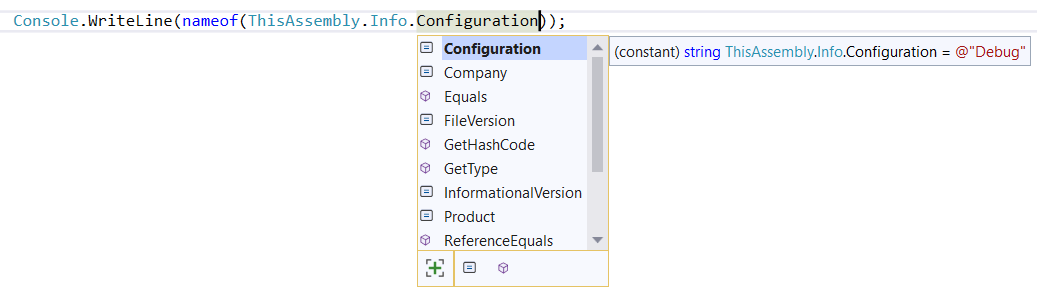
This package generates a static `ThisAssembly.Info` class with public constants exposing the following attribute values generated by default for SDK style projects: * AssemblyConfigurationAttribute * AssemblyCompanyAttribute * AssemblyTitleAttribute * AssemblyProductAttribute * AssemblyVersionAttribute * AssemblyInformationalVersionAttribute * AssemblyFileVersionAttribute If your project includes these attributes by other means, they will still be emitted properly on the `ThisAssembly.Info` class.
Get Started
$ dotnet add package ThisAssembly.AssemblyInfoReadme
<!-- include https://github.com/devlooped/.github/raw/main/sponsorlinkr.md -->
This project uses SponsorLink to attribute sponsor status (direct, indirect or implicit). For IDE usage, sponsor status is required. IDE-only warnings will be issued after a grace period otherwise.
<!-- https://github.com/devlooped/.github/raw/main/sponsorlinkr.md --> <!-- #assembly -->This package generates a static ThisAssembly.Info class with public
constants exposing the following attribute values generated by default for SDK style projects:
-
AssemblyConfigurationAttribute
-
AssemblyCompanyAttribute
-
AssemblyTitleAttribute
-
AssemblyDescriptionAttribute
-
AssemblyProductAttribute
-
AssemblyCopyrightAttribute
-
AssemblyVersionAttribute
-
AssemblyInformationalVersionAttribute
-
AssemblyFileVersionAttribute
If your project includes these attributes by other means, they will still be emitted properly
on the ThisAssembly.Info class.
Customizing the generated code
Set the $(ThisAssemblyNamespace) MSBuild property to set the namespace of the
generated ThisAssembly root class. Otherwise, it will be generated in the global namespace.
The generated root ThisAssembly class is partial and has no visibility modifier by default,
making it internal by default in C#.
You can set the $(ThisAssemblyVisibility) MSBuild property to public to make it public.
This will also change all constants to be static readonly properties instead.
Default:
partial class ThisAssembly
{
    public partial class Constants
    {
        public const string Hello = "World";
    }
}