A robust, flexible, extensible, pure .NET framework to facilitate dynamic data-driven testing.
- Test data conversion, management and provisioning
- Type-safe and thread-safe support for *MSTest*, *NUnit*, *xUnit*, *xUnit.v3*
- Modular design, abstractions and ready-to-use integrations
- Portable data sources
- Traceable descriptive display names
CsabaDu.DynamicTestData is a lightweight, robust, flexible and extensible, type- and thread-safe C# framework, designed to facilitate dynamic data-driven testing in MSTest, NUnit or xUnit frameworks, by providing simple and intuitive ways to generate test cases at runtime with literal names.
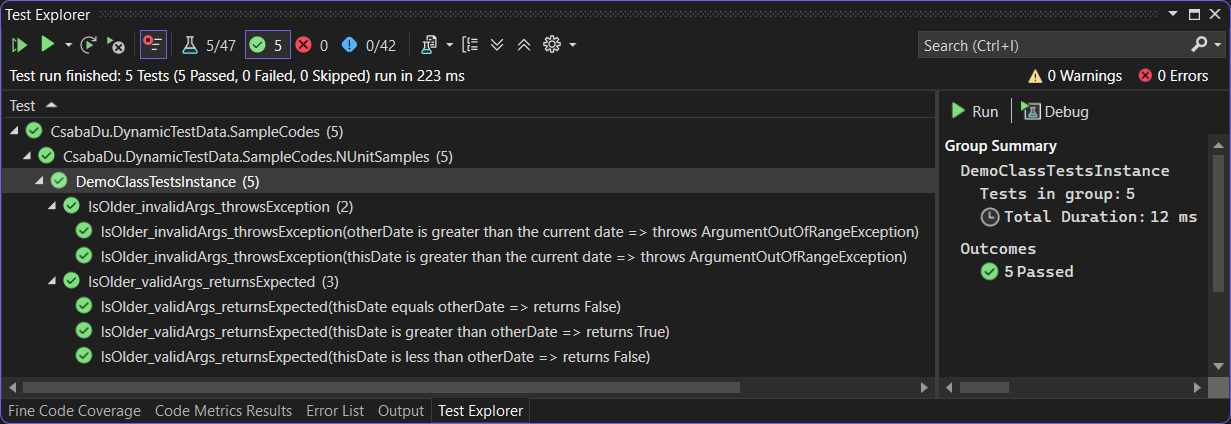
CsabaDu.DynamicTestData framework is particularly useful in a unit testing context, where it can help streamline the creation of test cases and ensure that tests are both comprehensive and easy to maintain. It is designed to be highly flexible and extensible, allowing developers to create and manage test data for a wide variety of scenarios and literal test case descriptions displaying in Visual Studio Test Explorer.
This framework consists of immutable TestData record types to initialize, store and proceed parameters of dynamic data-driven tests in runtime. It supports tests with multiple arguments, expected not null ValueType results and exceptions. It contains a DynamicDataSource base class with fully implemented methods to create specific object arrays of the data stored in the record instances. You get ready-to-use methods to create enumeration members of the derived dynamic data source classes. The use of generics and records ensures type safety and immutability, while the ArgsCode enum provides a clear way to specify how arguments should be handled.
It is a lightweight but robust framework. It does not have outer dependencies so it is portable, you can use with any test framework in Visual Studio. However consider the limitations of its usage and extensibility mentioned where applicable.
What's New?
Version 1.6.0
New Features:
ITestCase : IEquatable<ITestCase> added to segregate the string TestCase property of the inherited ITestData interface, and to make the equality of two ITestData instances comparable, based on their TestCase property.
static object?[] TestDataToParams([NotNull] ITestData testData, ArgsCode argsCode, bool withExpected, out string testCase) method added to the DynamicDataSource class to null-check the ITestData testData parameter and get the value of its string TestCase property as out-parameter.
Compatibility:
This update is fully backward-compatible with previous versions. Existing solutions will continue to work without any changes.
Features
(Updated v1.6.0)
Generic TestData Types:
The TestData record and its derived types (TestDataReturns, TestDataThrows) are generic and support up to nine arguments (T1 to T9).
This allows for flexible test data creation for methods with varying numbers of parameters.
ValueType Support (Updated v1.4.0):
The TestDataReturns record with struct constraint is designed for test cases that expect returning a not null ValueType.
It ensures that the expected result is a not null ValueType and provides methods to convert the test data into arguments.
Exception Support:
The TestDataThrows record is specifically designed for test cases that expect exceptions to be thrown.
It includes the expected Exception type and any arguments required for the test.
DynamicDataSource Abstract Class (Updated v1.6.0):
The DynamicDataSource class provides methods (TestDataToArgs, TestDataReturnsToArgs, TestDataThrowsToArgs) to convert test data into arguments for test methods.
These methods use the ArgsCode to determine how to convert the test data.
The OptionalToArgs method makes possible the thread-safe temporary overriding of the original (default) ArgsCode property value. (New v1.1.0)
The class provides static methods for generating test data rows (TestDataToParams) and test display name (GetDisplayName).
ArgsCode Enum:
The ArgsCode enum specifies the strategy how test data should be converted into arguments. For example:
ArgsCode.Instance: Uses the test data instance itself as an argument.
ArgsCode.Properties: Uses the properties of the test data as arguments.
Dynamic Data Generation:
Designed to easily generate test data dynamically at runtime.
Type Safety:
Ensures type safety for generated test data with using TestData generic types for test parameter set creation.
Thread Safety
The generated TestData record types' immutability ensures thread safety.
Readability:
The TestCase property of the TestData types is designed to create a literal test description to display in Visual Studio Test Explorer.
Portability:
The framework does not have outer dependencies.
Easy to integrate with your existing test frameworks.
Enhanced Flexibility (New v1.1.0):
You can generate exceptionally different type object array lists in the same test method with optional ArgsCode? parameter.
Extensibility: (Updated v1.6.0)
The framework is highly extensible. You can add new dynamic data source classes or test data types to suit your needs. You can extend the recent implementations or create new ones with implementing ITestData derived interfaces.
Using exceptionally different optional ArgsCode? is extensible, either with functionts and processes. (New v1.2.0)
PropertiesToArgs and ToParams methods of ITestData interface are useful for passing the selected properties of the TestData instance to a test framework defined test data type. (Updated 1.5.0)
IExpected interface facilitates to early access primary type argument value of generic data type instances via non-generic base interface types. (New 1.5.0)
ITestCase interface facilitates to compare the equality of two test case instances based on their TestCase property value. (New 1.6.0)
TestDataToParams static method of DynamicDataSource class is useful for generating test parameters from a null-checked ITestData instance, and getting the TestCase property value of the ITestData instance as out parameter. (New 1.6.0)
Quick Start
(Updated v1.1.0)
Install the NuGet package:
Run the following command in the NuGet Package Manager Console:
Install-Package CsabaDu.DynamicTestData
Create a derived dynamic test data source class:
Create one class for each test class separately that extends the DynamicDataSource base class.
Implement IEnumerable<object?[]> returning type methods to generate test data.
Use the TestDataToArgs, TestDataReturnsToArgs, and TestDataThrowsToArgs methods to create test data rows within the methods.
Use the OptionalToArgs method along with the object array generating methods. (New v1.1.0)
Insert the dynamic test data source in the test class:
Declare a static instance of the derived dynamic data source class in the test class and initialize it with either ArgsCode.Instance or ArgsCode.Properties parameter.
Declare static IEnumerable<object?[]> properties or methods to call the test data generated by the dynamic data source class.
Override the default ArgsCode value of any data source method by adding ArgsCodeparameter to the called method. (New v1.1.0)
Use dynamic test data source members in the test methods:
Use the DynamicData attribute in MSTest, TestCaseSource attribute in NUnit, or MemberData attribute in xUnit to pass the test data to the test methods.
Initialize the attribute with the belonging dynamic data source member name.
Purpose: Specifies the strategy of different ways to generate test data to an array of arguments.
Values:
Instance: Represents the instance of the test data type instance.
Properties: Represents the properties of the test data type instance.
Extensions Static Class
Purpose: Provides extension methods for adding elements to object arrays and validating ArgsCode enum parameters.
Methods:
Add<T>(this object?[] args, ArgsCode argsCode, T? parameter): Adds a parameter to the array of arguments based on the specified ArgsCode.
Defined(this ArgsCode argsCode, string paramName): Validates whether the specified ArgsCode is defined in the enumeration.
GetInvalidEnumArgumentException(this ArgsCode argsCode, string paramName): Creates a new InvalidEnumArgumentException for the specified ArgsCode value.
IExpected interface (New v1.5.0)
Purpose: Represents a base interface for test data that has a primary test parameter for test case result.
Methods:
GetExpected(): Returns the value of the expected primary test parameter.
ITestCase interface (New v1.6.0)
Purpose: Represents a test case interface with properties for test case description and equality comparison.
Properties:
TestCase: Gets the test case description.
Methods:
bool Equals(ITestCase? other): Compares two ITestCase instances based on their TestCase property value.
ITestDataReturns interface (New v1.3.0)
Purpose: Represents a base marker interface for test data that returns a value.
ITestDataThrows interface (New v1.3.0)
Purpose: Represents a base marker interface for test data that throws an exception.
ITestData Interface (Updated v1.5.0)
Purpose: Represents a test data interface with properties for test case and result, and a method to convert arguments.
Properties:
Definition: Gets the definition of the test case.
ExitMode: Gets the expected exit mode of the test.
Result: Gets the name of the expected result of the test case.
Methods (Updated v1.5.0):
ToArgs(ArgsCode argsCode): Converts the ITestData instance to an array of arguments based on the specified ArgsCode.
PropertiesToArgs(bool withExpected) (New v1.4.0): Converts the selected properties of the ITestData instance to an array of objects, with or without the Expected property value as defined by the bool withExpected parameter.
ToParams(ArgsCode argsCode, bool withExpected) (New 1.5.0): Returns PropertiesToArgs method if ArgsCode argsCode parameter value is ArgsCode.Properties, otherwise ToArgs(ArgsCode argsCode)` method.
ITestData<TResult> Interface
Purpose: Represents a generic test data interface that extends ITestData.
Property:
Expected: Gets the expected result of the test case.
ITestData<TResult, T1, T2, ..., T9> Interfaces
Purpose: Represent generic test data interfaces that extend ITestData<TResult> with additional arguments.
Properties:
Arg1, Arg2, ..., Arg9: Get the respective arguments of the test case.
TestData Abstract Record (Updated v1.4.0)
Purpose: Represents an abstract record for test data.
Properties:
Definition: The definition of the test data.
ExitMode: The expected exit mode of the test case.
Result: The result name of the test case.
TestCase: The test case string representation.
Methods (Updated v1.4.0):
ToArgs(ArgsCode argsCode): Converts the test data to an array of arguments based on the specified ArgsCode.
PropertiesToArgs(bool withExpected) (New v1.4.0): Abstract method to be implemented in derived classes.
ToParams(ArgsCode argsCode, bool withExpected) (New 1.5.0): Returns PropertiesToArgs method if ArgsCode argsCode parameter value is ArgsCode.Properties, otherwise ToArgs(ArgsCode argsCode) method.
ToString (Updated v1.4.0): Overrides and seals the ToString method to return the value of TestCase property.
TestData<T1, T2, ..., T9> Records (Updated v1.4.0)
Purpose: Represent concrete records for test data with one to nine arguments.
Method:
ToArgs(ArgsCode argsCode) (New v1.4.0): Overrides the base method to add the respective arguments to the array.
PropertiesToArgs(bool withExpected): Overrides and seals the abstract method in the TestData<T1> type with the behavior defined in the ITestData secction. (In the generic TestData instances this method always return the properties without the Expected property value.)
TestDataReturns<TStruct> Abstract Record (Updated v1.5.0)
Purpose: Represents an abstract class for test data that returns a value of type TStruct, which must be a not null `ValueType'.
Properties:
Expected: The primary test parameter of type TStruct.
Methods (New v1.5.0):
GetExpected(): Returns the value of the Expected property.
TestDataReturns<TStruct, T1, T2, ..., T9> Records (Updated v1.4.0)
Purpose: Represent records for test data that returns a not null `ValueType' with one to nine additional arguments.
Method:
ToArgs(ArgsCode argsCode): Overrides the base method to add the respective arguments to the array.
PropertiesToArgs(bool withExpected) (New v1.4.0): Overrides and seals the abstract method in the TestDataReturns<TStruct, T1> type with the behavior defined in the ITestData secction.
TestDataThrows<TException> Abstract Record (Updated v1.5.0)
Purpose: Represents an an abstract class for test data that throws exceptions of type TException.
Properties:
Expected: The primary test parameter of type TException.
Methods (New v1.5.0):
GetExpected(): Returns the value of the Expected property.
TestDataThrows<TException, T1, T2, ..., T9> Records (Updated v1.4.0)
Purpose: Represent records for test data that throws exceptions with one to nine additional arguments.
Method:
ToArgs(ArgsCode argsCode): Overrides the base method to add the respective arguments to the array.
PropertiesToArgs(bool withExpected) (New v1.4.0): Overrides and seals the abstract method in the TestDataThrowss<TException, T1> type with the behavior defined in the ITestData secction.
DynamicDataSource Abstract Class
(Updated v1.6.0)
Purpose: Represents an abstract base class for dynamic data source classes and provides features to facilitate generating test data.
Properties:
ArgsCode (Updated v1.1.0): Gets the current ArgsCode value used for argument conversion, which is either the temporary override value or the default value.
Methods:
GetDisplayName(string? testMethodName, params object?[]? args)(Updated v1.5.3): Gets the display name of the test method and the test case description or returns null.
estDataToParams([NotNull] ITestData testData, ArgsCode argsCode, bool withExpected, out string testCase) (New v1.6.0): Converts test data to an array of arguments for tests with one to nine arguments, and gets the TestCase property of the ITestData testData parameter as out parameter.
TestDataToArgs<T1, T2, ..., T9>(...): Converts test data to an array of arguments for tests with one to nine arguments.
TestDataReturnsToArgs<TStruct, T1, T2, ..., T9>(...): Converts test data to an array of arguments for tests that expect a not null `ValueType' to assert.
TestDataThrowsToArgs<TException, T1, T2, ..., T9>(...): Converts test data to an array of arguments for tests that throw exceptions.
OptionalToArgs([NotNull] Func<object?[]> testDataToArgs, ArgsCode? argsCode) (New v1.1.0): Executes the provided test data function with an optional temporary ArgsCode override.
How it Works
(Updated v1.6.0)
ArgsCode Enum
Every test frameworks accept object arrays as dynamic data-driven tests' data rows. The test parameters should be the object array elements. Other approach is that the object array contains a single object element, and the tests' parameters can be the properties of this object element.
CsabaDu.DynamicTestData supports both approaches, you can generate object arrays with either content. The outcome of the object array generator methods is controlled with the dedicated enum ArgsCode type parameter having two self-explanatory values:
namespace CsabaDu.DynamicTestData.DynamicDataSources;

public enum ArgsCode
{
    Instance,
    Properties,
}
ArgsCode.Instance represents the instance of the test data type instance.
ArgsCode.Properties represents the properties of the test data type instance.
ArgsCode will be used as basic parameter of the object array generator methods.
object?[] type is extended with a method to facilitate test data object arrays creation. Besides the object array which calls it, the method requires two parameters. In case of Properties value of the first ArgsCode argument the method increases the returning object array's elements with the new parameter as last one there, in case of Instance value it returns the original object array, otherwise it throws an InvalidEnumArgumentException.
ArgsCode Extension Methods
ArgsCode type is extended with guarding methods to validate the value of the ArgsCode type parameter:
Defined method returns the ArgsCode parameter if valid, otherwise throws an InvalidEnumArgumentException.
GetInvalidEnumArgumentException just returns an InvalidEnumArgumentException instance with the pre-set parameters.
ITestData Base Interfaces
(Updated v1.6.0)
CsabaDu.DynamicTestData provides three extendable base record types, and their concrete generic implementations of strongly typed parameters with T1 - T9 open generic types.
Each TestData type implements the following interfaces:
namespace CsabaDu.DynamicTestData.TestDataTypes.Interfaces;

public interface ITestData
: ITestCase
{
    string Definition { get; }
    string? ExitMode { get; }
    string Result { get; }

    // Change in v1.6.0:
    // 'string TestCase' property is shifted to the new
    // 'ITestCase' interface (see later).

    object?[] ToArgs(ArgsCode argsCode);

    // New feature v1.5.0
    object?[] ToParams(ArgsCode argsCode, bool withExpected);

    // New feature v1.4.0
    object?[] PropertiesToArgs(bool withExpected);
}

public interface ITestData<out TResult>
: ITestData
where TResult : notnull
{
    TResult Expected { get; }
}
ITestData is the base interface of three inheritance lines. All derived types implement an abstract class each which implements a dedicated interface derived from the ITestData<out TResult> interface. Inherited types are TestData, TestDataReturns<TStruct> and TestDataThrows<TException>.
The other inheritance line of the ITestData<out TResult> interface remains abstract and each concrete type inherits one. You can approach the different specified types having same test parameter types by calling these Interfaces:
namespace CsabaDu.DynamicTestData.TestDataTypes.Interfaces;

public interface ITestData<out TResult, out T1>
: ITestData<TResult>
where TResult : notnull
{
    T1? Arg1 { get; }
}

public interface ITestData<out TResult, out T1, out T2>
: ITestData<TResult, T1>
where TResult : notnull
{
    T2? Arg2 { get; }
}

// And similar extended inheritances till T9 type argument.
ITestData Properties
(Updated v1.6.0)
All types have five common properties.
Two properties are injected as first two parameters to each derived concrete types' constructors:
string Definition to describe the test case parameters to be asserted.
TResult Expected, a generic type property with notnull constraint.
T1? Arg1...T9? Arg9, one to nine piece of nullable generic type test parameters
Additional properties are generated as follows:
string ExitMode property gets a constant string declared in the derived types. This implementation gets the following strings in the derived types:
TestData: null,
TestDataReturns<TStruct>: "returns",
TestDataThrows<TException>: "throws".
string Result property gets the appropriate string representation of the Expected property.
ITestData Methods
(Updated v1.6.0)
ITestData interface defines the following methods:
object?[] ToArgs(ArgsCode argsCode) method's intended behavior is to generate an object array from the ITestData instance in two ways: The returning object array should contain
either the selected properties of the ITestData instance
or the ITestData instance itself.
object?[] PropertiesToArgs(bool withExpected) (New v1.4.0): method's intended behavior is to generate an object array from ITestData instance which - unlike the object array returned in ToArgs(ArgsCode.Properties) case - contains the test parameters only,
without the TestCase property value,
and with or without the Expected property value where it is applicable, as defined by the bool withExpected parameter.
object?[] ToParams(ArgsCode argsCode, bool withExpected) (New v1.6.0) method's intended behavior is to returns the PropertiesToArgs method if argsCode parameter is ArgsCode.Properties, and the ToArgs method if ArgsCode.Instance.
ITestCase Interface
(New v1.6.0)
ITestCase interface is segregated from the ITestData interface's original implementation. Besides it defines string TestCase property of the test data types in version 1.6.0, it inherits the IEquatable<ITestCase> system interface. It is necessary when running dynamic data driven tests in async mode, when the same tests may run several times and the generated test parameters may differ of the duplicated test cases. (See sample code for such test data in the Test Framework Independent Dynamic Data Source section.)
string TestCase property gets the test case description. This text is created from the other properties in the following ways:
If ExitMode property gets null or an empty string: $"{Definition} => {Result}",
bool IEquatable<ITestCase> Equals(ITestCase? other) method's intended implementation is to compare two ITestCase instance based on their TestCase property value and return with true if they are equal, otherwise false.
The purpose of this interface is to mark those inherited TestData types which are expected to contain a primary test parameter.
The interface defines the object GetExpected() method which facilitates accessing the Expected property of the derived generic TestData instances
namespace CsabaDu.DynamicTestData.TestDataTypes.Interfaces;

public interface IExpected
{
    object GetExpected();
}
ITestDataReturns and ITestDataThrows Marker Interfaces
(Updated v1.5.0)
namespace CsabaDu.DynamicTestData.TestDataTypes.Interfaces
{
    public interface ITestDataReturns : IExpected;

    public interface ITestDataThrows : IExpected;
}
These non-generic base marker interfaces were added to call derived types. Purpose of these interfaces is to enhance extensibility. Both are derived from the IExpected base interface.
See the whole ITestData interface inheritance structure on the below picture:
(Updated v1.5.0)
TestData Record Types
(Updated v1.6.0)
All concrete TestData types are inherited from the abstract record TestData type. Its primary constructor with the object?[] ToArgs(ArgsCode argsCode) method's virtual implementation looks like:
namespace CsabaDu.DynamicTestData.TestDataTypes;

public abstract record TestData(
    string Definition,
    string? ExitMode,
    string Result)
: ITestData
{
    internal const string Returns = "returns";
    internal const string Throws = "throws";

    #region Code adjustments v1.3.1
    private readonly string definitionOrName = GetValueOrSubstitute(Definition, nameof(Definition));
    private readonly string resultOrName = GetValueOrSubstitute(Result, nameof(Result));
    private readonly string exitModeOrEmpty = GetValueOrSubstitute(ExitMode, string.Empty);

    public string TestCase
    => $"{definitionOrName} => {exitModeOrEmpty}{resultOrName}";

    private static string GetValueOrSubstitute(string? value, string substitute)
    => string.IsNullOrEmpty(value) ?
        substitute
        : substitute == string.Empty ?
            value + " "
            : value;
    #endregion Code adjustments v1.3.1

    public virtual object?[] ToArgs(ArgsCode argsCode) => argsCode switch
    {
        ArgsCode.Instance => [this],
        ArgsCode.Properties => [TestCase],
        _ => throw argsCode.GetInvalidEnumArgumentException(nameof(argsCode)),
    };

    // New feature v1.6.0
    public bool Equals(ITestCase? other)
    => other is not null
        && other.TestCase == TestCase;

    // New feature v1.5.0
    public object?[] ToParams(ArgsCode argsCode, bool withExpected)
    => argsCode == ArgsCode.Properties ?
        PropertiesToArgs(withExpected)
        : ToArgs(argsCode);

    public override sealed string ToString() => TestCase;

    // New feature v1.4.0
    public abstract object?[] PropertiesToArgs(bool withExpected);

    // This method is called by the override 'PropertiesToArgs' methods
    // in the derived generic concrete 'TestData<>' instances.
    protected static object?[] PropertiesToArgs(
        TestData? testData,
        bool withExpected)
    {
        int count = propertiesToArgs()?.Length ?? 0;

        if (withExpected && count > 1)
        {
            return propertiesToArgs()![1..];
        }

        if (count > 2)
        {
            return propertiesToArgs()![2..];
        }

        throw new InvalidOperationException(
            "The test data properties count is " +
            "not enough for the current operation.");

        #region Local methods
        object?[]? propertiesToArgs()
        => testData?.ToArgs(ArgsCode.Properties);
        #endregion
    }
}
In the derived concrete TestData types the overriden object?[] ToArgs(ArgsCode argsCode) methods will increase the returning object array of the parent record with the recently added parameter in case of ArgsCode.Properties parameter, otherwise it will return an object array containing the given instance. Using the object?[] Add<T>(this object?[] args, T? arg) extension method, the overriden methods' implementations are uniform as you will see.
This type overrides and seals the string ToString() method with returning the TestCase property's value. When the instance is used as test method parameter, the test case display name will be the string representation of the instance.
All derived types of TestData base type implement the ITestdata<out TResult> : ITestData interface. TestData concrete types will inherit direcly from the abstract TestData record, other types will inherit via TestDataReturns<TStruct> and TestDataThrows<TException> intermediate abstract types.
TestData
(Updated v1.4.0)
Implements the following interface:
namespace CsabaDu.DynamicTestData.TestDataTypes.Interfaces;

public interface ITestData<string>
: ITestData
General purposes type ITestData.
Expected property's type is string. The expected test case result should be written down literally.
Concrete TestData types primary constructors with the overriden object?[] ToArgs(ArgsCode argsCode) methods look like:
namespace CsabaDu.DynamicTestData.TestDataTypes;

public record TestData<T1>(
    string Definition,
    string Expected,
    T1? Arg1)
: TestData(
    Definition,
    null,
    string.IsNullOrEmpty(Expected) ? nameof(Expected) : Expected),
ITestData<string, T1>
{
    public override object?[] ToArgs(ArgsCode argsCode)
    => base.ToArgs(argsCode).Add(argsCode, Arg1);

    // New feature v1.4.0
    public override sealed object?[] PropertiesToArgs(bool withExpected)
    => PropertiesToArgs(this, true);
}

public record TestData<T1, T2>(
    string Definition,
    string Expected,
    T1? Arg1, T2? Arg2)
: TestData<T1>(
    Definition,
    Expected,
    Arg1),
ITestData<string, T1, T2>
{
    public override object?[] ToArgs(ArgsCode argsCode)
    => base.ToArgs(argsCode).Add(argsCode, Arg2);
}

// And similar extended inheritances till T9 type argument.
Note that the PropertiesToArgs method in the generic TestData instances always return the properties without the Expected property value. This is because the Expected property is a literal description of the expected result, not a test parameter:[Arg1...Arg9]
TestDataReturns
(Updated v1.5.0)
Implements the following interface:
namespace CsabaDu.DynamicTestData.TestDataTypes.Interfaces;

public interface ITestDataReturns<out TStruct>
: ITestDataReturns, ITestData<TStruct>
where TStruct : struct;
Designed to assert the comparison of numbers, booleans, enums, and other not null ValueType values.
Expected property's type is not null ValueType (as this is the actual type definition of the struct constraint).
The abstract TestDataReturns<TStruct> type and its concrete derived types' primary constructors with the overriden object?[] ToArgs(ArgsCode argsCode) methods look like:
namespace CsabaDu.DynamicTestData.TestDataTypes;

public abstract record TestDataReturns<TStruct>(
    string Definition,
    TStruct Expected)
: TestData(
    Definition,
    Returns,
    Expected.ToString() ?? nameof(Expected)),
ITestDataReturns<TStruct>
where TStruct : struct
{
    // New feature v1.5.0
    public object GetExpected() => Expected;

    public override object?[] ToArgs(ArgsCode argsCode)
    => base.ToArgs(argsCode).Add(argsCode, Expected);
}

public record TestDataReturns<TStruct, T1>(
    string Definition,
    TStruct Expected,
    T1? Arg1)
: TestDataReturns<TStruct>(
    Definition,
    Expected),
ITestData<TStruct, T1>
where TStruct : struct
{
    public override object?[] ToArgs(ArgsCode argsCode)
    => base.ToArgs(argsCode).Add(argsCode, Arg1);

    // New feature v1.4.0
    public override sealed object?[] PropertiesToArgs(bool withExpected)
    => PropertiesToArgs(this, withExpected);
}

public record TestDataReturns<TStruct, T1, T2>(
    string Definition,
    TStruct Expected,
    T1? Arg1, T2? Arg2)
: TestDataReturns<TStruct, T1>(
    Definition,
    Expected,
    Arg1),
ITestData<TStruct, T1, T2>
where TStruct : struct
{
    public override object?[] ToArgs(ArgsCode argsCode)
    => base.ToArgs(argsCode).Add(argsCode, Arg2);
}

// And similar extended inheritances till T9 type argument.
PropertiesToArgs method returns if bool withExpected parameter is
true: [Expected, Arg1...Arg9],
false: [Arg1...Arg9]
TestDataThrows
(Updated v1.5.0)
Implements the following interface:
namespace CsabaDu.DynamicTestData.TestDataTypes.Interfaces;

public interface ITestDataThrows<out TException>
: ITestDataThrows, ITestData<TException>
where TException : Exception;
Designed for test cases where the expected result to be asserted is a thrown Exception.
Expected property's type is Exception.
The abstract TestDataThrows<TException> type and its concrete derived types' primary constructors with the overriden object?[] ToArgs(ArgsCode argsCode) methods look like:
namespace CsabaDu.DynamicTestData.TestDataTypes;

public abstract record TestDataThrows<TException>(
    string Definition,
    TException Expected)
: TestData(
    Definition,
    Throws,
    typeof(TException).Name),
ITestDataThrows<TException>
where TException : Exception
{
    // New feature v1.5.0
    public object GetExpected() => Expected;

    public override object?[] ToArgs(ArgsCode argsCode)
    => base.ToArgs(argsCode).Add(argsCode, Expected);
}

public record TestDataThrows<TException, T1>(
    string Definition,
    TException Expected,
    T1? Arg1)
: TestDataThrows<TException>(
    Definition,
    Expected),
ITestData<TException, T1>
where TException : Exception
{
    public override object?[] ToArgs(ArgsCode argsCode)
    => base.ToArgs(argsCode).Add(argsCode, Arg1);

    // New feature v1.4.0
    public override sealed object?[] PropertiesToArgs(bool withExpected)
    => PropertiesToArgs(this, withExpected);
}

public record TestDataThrows<TException, T1, T2>(
    string Definition,
    TException Expected,
    T1? Arg1, T2? Arg2)
: TestDataThrows<TException, T1>(
    Definition,
    Expected,
    Arg1),
ITestData<TException, T1, T2>
where TException : Exception
{
    public override object?[] ToArgs(ArgsCode argsCode)
    => base.ToArgs(argsCode).Add(argsCode, Arg2);
}

// And similar extended inheritances till T9 type argument.
PropertiesToArgs method returns if bool withExpected parameter is
true: [Expected, Arg1...Arg9],
false: [Arg1...Arg9]
Abstract DynamicDataSource Class
(Updated v1.5.3)
This class contains the methods to create specific object arrays for dynamic data-driven tests' data row purposes from every TestData types. Once you call an object array generator method of the class, you create a new TestData child instance inside and call its object?[] ToArgs(ArgsCode argsCode) method to create the object array for dynamic test data record purposes.
However DynamicDataSource class implements all necessary methods for test data preparation, it is marked as abstract. Intended usage is to
extend this class for each test class separately,
implement the necessary specific methods in the derived class with IEnumerable<object[]> returning types, and
declare a static instance of the derived class in the test class where it is going to be used.
You can implement its children as test framework independent portable dynamic data source types. Moreover, using a test framework in the derived classes, you can create specific types either like TestCaseData type data rows of NUnit. You will find sample codes of these in the Advanced Usage section below.
namespace CsabaDu.DynamicTestData.DynamicDataSources;

public abstract class DynamicDataSource
{
    #region Code adjustments v1.1.0
    // New: Fields to store default ArgsCode value
    // and to ensure thread-safe temporary overriding it.
    private readonly ArgsCode _argsCode; // Default ArgsCode value
    private readonly AsyncLocal<ArgsCode?> _tempArgsCode = new(); // Temporary override ArgsCode value holder

    // Adjusted: Gets the current ArgsCode value,
    // which is either the temporary override value or the default value.
    protected ArgsCode ArgsCode => _tempArgsCode.Value ?? _argsCode;

    // Adjusted: Protected constructor initializing new fields.
    protected DynamicDataSource(ArgsCode argsCode)
    {
        _argsCode = argsCode.Defined(nameof(argsCode));
        _tempArgsCode.Value = null;
    }

    // New: A disposable class that manages thread-safe temporary ArgsCode overrides
    // and restores the previous value when disposed.
    private sealed class DisposableMemento : IDisposable
    {
        [NotNull]
        private readonly DynamicDataSource _dataSource;
        private readonly ArgsCode? _tempArgsCodeValue;
        private bool _disposed = false;

        internal DisposableMemento(DynamicDataSource dataSource, ArgsCode argsCode)
        {
            _dataSource = dataSource ?? throw new ArgumentNullException(nameof(dataSource));
            _tempArgsCodeValue = _dataSource._tempArgsCode.Value;
            _dataSource._tempArgsCode.Value = argsCode.Defined(nameof(argsCode));
        }

        public void Dispose()
        {
            if (_disposed) return;

            _dataSource._tempArgsCode.Value = _tempArgsCodeValue;
            _disposed = true;
        }
    }

    #region Code adjustments v1.2.0
    // Refactored: Calls a WithOptionalArgsCode method
    // with an optional temporary ArgsCode override.
    public object?[] OptionalToArgs(Func<object?[]> testDataToArgs, ArgsCode? argsCode)
    {
        ArgumentNullException.ThrowIfNull(testDataToArgs, nameof(testDataToArgs));
        return WithOptionalArgsCode(this, testDataToArgs, argsCode);
    }

    // New: Executes the provided test data function
    // with an optional temporary ArgsCode override.
    // This method is called by the OptionalToArgs method
    // and prepared to use in the derived data source classes either.
    protected static T WithOptionalArgsCode<TDataSource, T>(
        [NotNull] TDataSource dataSource,
        [NotNull] Func<T> testDataGenerator,
        ArgsCode? argsCode)
    where TDataSource : DynamicDataSource
    where T : notnull
    {
        if (!argsCode.HasValue)
        {
            return testDataGenerator();
        }

        using (new DisposableMemento(dataSource, argsCode.Value))
        {
            return testDataGenerator();
        }
    }

    // New: Executes the provided test data processor
    // with an optional temporary ArgsCode override.
    // This method is prepared to use in the derived data source classes.
    protected static void WithOptionalArgsCode<TDataSource>(
        [NotNull] TDataSource dataSource,
        [NotNull] Action testDataProcessor,
        ArgsCode? argsCode)
    where TDataSource : DynamicDataSource
    {
        if (!argsCode.HasValue)
        {
            testDataProcessor();
        }
        else using (new DisposableMemento(dataSource, argsCode.Value))
        {
            testDataProcessor();
        }
    }
    #endregion Code adjustments v1.2.0
    #endregion Code adjustments v1.1.0

    // Code adjustments v1.5.3
    // Change: Besides checking if test method name is null or an empty string,
    // the method returns null too if 'args' or the first element is null or empty or
    // the or 'ToString()' method of the first element returns null or an empty string.
    public static string? GetDisplayName(
        string? testMethodName,
        params object?[]? args)
    {
        if (string.IsNullOrEmpty(testMethodName))
        {
            return null;
        }

        var firstElement = args?.FirstOrDefault();

        return !string.IsNullOrEmpty(firstElement?.ToString()) ?
            $"{testMethodName}({firstElement})"
            : null;
    }

    // New feature v1.6.0: This method calls the
    // 'ITestData.ToParams' method with the null-check of the caller
    // 'ITestData' instance. When this method returns, the
    // 'out string testCase' parameter contains the value of the
    // 'TestCase' property from the provided 'testData' parameter.
    public static object?[] TestDataToParams(
        [NotNull] ITestData testData,
        ArgsCode argsCode,
        bool withExpected,
        out string testCase)
    {
        testCase = testData?.TestCase
            ?? throw new ArgumentNullException(nameof(testData));

        return testData.ToParams(argsCode, withExpected);
    }

    #region TestDataToArgs
    public object?[] TestDataToArgs<T1>(
        string definition,
        string expected,
        T1? arg1)
    => new TestData<T1>(
        definition,
        expected,
        arg1).ToArgs(ArgsCode);

    public object?[] TestDataToArgs<T1, T2>(
        string definition,
        string expected,
        T1? arg1, T2? arg2)
    => new TestData<T1, T2>(
        definition,
        expected,
        arg1, arg2).ToArgs(ArgsCode);

    // TestDataToArgs<> overloads here

    #endregion

    #region TestDataReturnsToArgs
    public object?[] TestDataReturnsToArgs<TStruct, T1>(
        string definition,
        TStruct expected,
        T1? arg1)
    where TStruct : struct
    => new TestDataReturns<TStruct, T1>(
        definition,
        expected,
        arg1).ToArgs(ArgsCode);

    public object?[] TestDataReturnsToArgs<TStruct, T1, T2>(
        string definition,
        TStruct expected,
        T1? arg1, T2? arg2)
    where TStruct : struct
    => new TestDataReturns<TStruct, T1, T2>(
        definition,
        expected,
        arg1, arg2).ToArgs(ArgsCode);

    // TestDataReturnsToArgs<> overloads here

    #endregion

    #region TestDataThrowsToArgs
    public object?[] TestDataThrowsToArgs<TException, T1>(
        string definition,
        TException expected,
        T1? arg1)
    where TException : Exception
    => new TestDataThrows<TException, T1>(
        definition,
        expected,
        arg1).ToArgs(ArgsCode);

    public object?[] TestDataThrowsToArgs<TException, T1, T2>(
        string definition,
        TException expected,
        T1? arg1, T2? arg2)
    where TException : Exception
    => new TestDataThrows<TException, T1, T2>(
        definition,
        expected,
        arg1, arg2).ToArgs(ArgsCode);

    // TestDataThrowsToArgs<> overloads here

    #endregion
}
Protected ArgsCode Property
(Updated v1.1.0)
ArgsCode ArgsCode is the only property of DynamicDataSource class. This property is marked as protected. It should be initalized with the constructor parameter of the class. This property will be the parameter of the ToArgs methods called by the object array generator methods of the class
Static GetDisplayName Method
(Updated v1.5.2)
This method is prepared to facilitate displaying the required literal testcase description in MSTest and NUnit framewoks. You will find sample code for MSTest usage in the Usage, for NUnit usage in the Advanced Usage sections below.
The method is implemented to support initializing the MSTest framework's DynamicDataAttribute.DynamicDataDisplayName property. Following the testmethod's name, the injected object array's first element will be used as string. This element in case of ArgsCode.Properties is the TestCase property of the instance, and the instance's string representation in case of ArgsCode.Instance. This is the TestCase property's value either as the ToString() method returns that.
Static TestDataToParams Method
(New v1.6.0)
This method calls the ToParams method of the null-checked ITestData testData parameter. When this method returns, the out string testCase parameter contains the value of the TestCase property from the provided testData parameter.
Object Array Generator Methods
DynamicDataSource class provides a dedicated object array generator each TestData type. The methods' parameters types and sequences are the same as the constructors' parameters of the related TestData types.
In case of ArgsCode.Properties parameter, the returning object array content is as follows:
[TestCase, Expected, Arg1 ... Arg9].
Embedded Private DisposableMemento Class
(New v1.1.0)
This embedded class follows the thread-safe Memento design pattern. Its function is to make possible the thread-safe temporary overriding of the ArgsCode property value by storing and ensuring to restore the original value. Its constructor's first parameter should be an instance of the eclosing DynamicDataSource class, and the second one is an ArgsCode enum to override its default ArgsCode property value. The class implements the IDIsposable interface, and its Dispose method sets the ArgsCode property with the original (default) value.
OptionalToArgs Method
(Updated v1.2.0)
The function of this method is to invoke the object array generator TestDataToArgs, TestDataReturnsToArgs or TestDataThrowsToArgs method given as Func<object[]> parameter to its signature. If the second optional ArgsCode? parameter is not null, the ArgsCode value of the initialized DynamicDataSource child instance will be overriden temporarily in a using block of the DisposableMemento class. Note that overriding the default ArgsCode is expensive so apply for it just occasionally. However, using this method with null value ArgsCode? parameter does not have significant impact on the performance yet.
These two method overrides are to proceed the test data generation with optional ArgsCode? parameter. The first one is for the Func<T> type test data generator methods, the second one is for the Action type test data processor methods. Both methods have the same signature with the OptionalToArgs method, but the first one returns the result of the test data generator method, the second one is void. The methods are protected and prepared to use in the derived data source classes either.
Usage
(Updated v1.2.0)
Here are some basic examples of how to use CsabaDu.DynamicTestData in your project.
Sample DemoClass
The following bool IsOlder(DateTime thisDate, DateTime otherDate) method of the DemoClass is going to be the subject of the below sample dynamic data source and test method codes.
The method compares two DateTime type arguments and returns true if the first is greater than the second one, otherwise false. The method throws an ArgumentOutOfRangeException if either argument is greater than the current date.
namespace CsabaDu.DynamicTestData.SampleCodes;

public class DemoClass
{
    public const string GreaterThanCurrentDateTimeMessage
        = "The DateTime parameter cannot be greater than the current date and time.";

    public bool IsOlder(DateTime thisDate, DateTime otherDate)
    {
        if (thisDate <= DateTime.Now && otherDate <= DateTime.Now)
        {
            return thisDate > otherDate;
        }

        throw new ArgumentOutOfRangeException(getParamName(), GreaterThanCurrentDateTimeMessage);

        #region Local methods
        string getParamName()
        => thisDate > DateTime.Now ? nameof(thisDate) : nameof(otherDate);
        #endregion
    }
}
Test Framework Independent Dynamic Data Source
(Updated v1.2.0)
You can easily implement test framework independent dynamic data source by extending the DynamicDataSource base class with IEnumerable<object?[]> type data source methods. You can use these directly in either test framework. You can easily adjust your already existing data source methods you used with version 1.0.x yet to have the benefits of the new feature (see comments in the sample code):
Add an optional ArgsCode? parameter to the data source methods signature.
Add optionalToArgs local method to the enclosing data source methods and call OptionalToArgs method with the testDataToArgs and argsCode parameters.
Call optionalToArgs local method to generate object arrays with data-driven test arguments .
However, note that this version is fully compatible backward, you can use the data source test classes and methods with the current version without any necessary change. The first data source method of the sample code remained unchanged as simpler but less flexible implememtation.
The 'native' dynamic data source class with the new feature looks like:
namespace CsabaDu.DynamicTestData.SampleCodes.DynamicDataSources;

public class NativeTestDataSource(ArgsCode argsCode) : DynamicDataSource(argsCode)
{
    private readonly DateTime DateTimeNow = DateTime.Now;

    private DateTime _thisDate;
    private DateTime _otherDate;

    public IEnumerable<object?[]> IsOlderReturnsArgsToList()
    {
        bool expected = true;
        string definition = "thisDate is greater than otherDate";
        _thisDate = DateTimeNow;
        _otherDate = DateTimeNow.AddDays(-1);
        yield return testDataToArgs();

        expected = false;
        definition = "thisDate equals otherDate";
        _otherDate = DateTimeNow;
        yield return testDataToArgs();

        definition = "thisDate is less than otherDate";
        _thisDate = DateTimeNow.AddDays(-1);
        yield return testDataToArgs();

        #region Local methods

        object?[] testDataToArgs()
        => TestDataReturnsToArgs(definition, expected, _thisDate, _otherDate);
        #endregion
    }

    // 1. Add an optional 'ArgsCode?' parameter to the method signature.
    public IEnumerable<object?[]> IsOlderThrowsArgsToList(ArgsCode? argsCode = null)
    {
        string paramName = "otherDate";
        _thisDate = DateTimeNow;
        _otherDate = DateTimeNow.AddDays(1);
        // 3. Call 'optionalToArgs' method.
        yield return optionalToArgs();

        paramName = "thisDate";
        _thisDate = DateTimeNow.AddDays(1);
        // 3. Call 'optionalToArgs' method.
        yield return optionalToArgs();

        #region Local methods
        // 2. Add 'optionalToArgs' local method to the enclosing method
        // and call 'OptionalToArgs' method with the testDataToArgs and argsCode parameters.
        object?[] optionalToArgs()
        => OptionalToArgs(testDataToArgs, argsCode);

        object?[] testDataToArgs()
        => TestDataThrowsToArgs(getDefinition(), getExpected(), _thisDate, _otherDate);

        string getDefinition()
        => $"{paramName} is greater than the current date";

        ArgumentOutOfRangeException getExpected()
        => new(paramName, DemoClass.GreaterThanCurrentDateTimeMessage);
        #endregion
    }
}
You can use this dynamic data source class initialized either with ArgsCode.Instance or ArgsCode.Properties in any test framework. You will find examples of both option for each yet. However, note that NUnit will display the test case as desired just with ArgsCode.Instance injection.
Usage in MSTest
Find MSTest sample codes for using TestData instance as test method parameter:
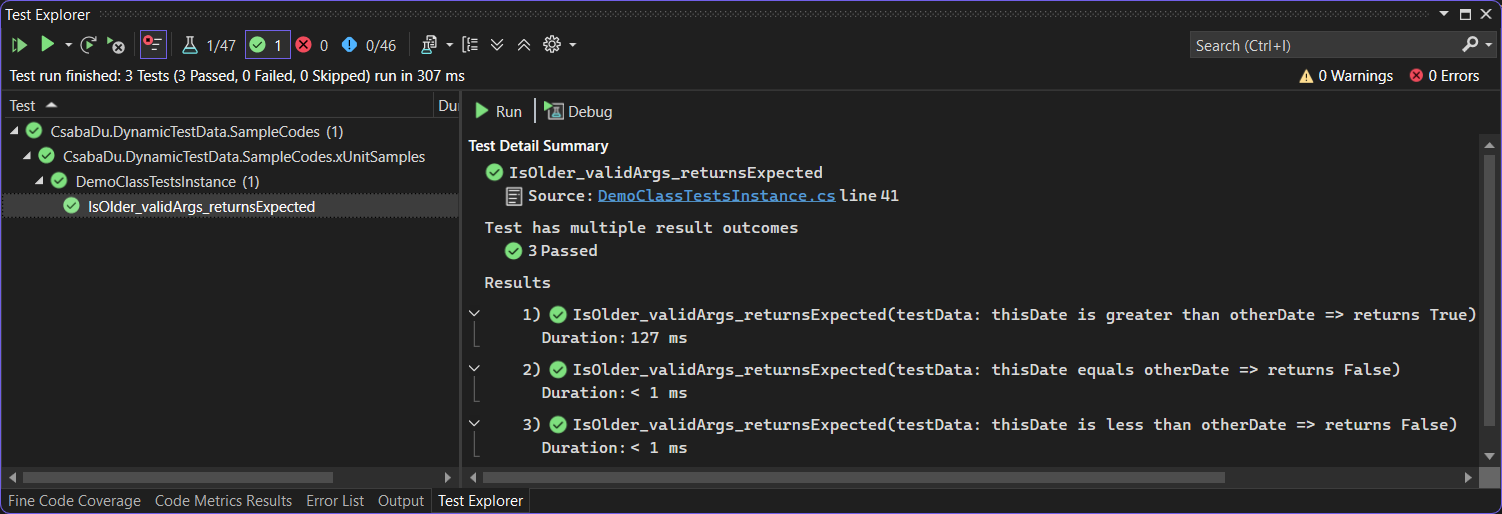
However CsabaDu.DynamicTestData works well with xUnit, note that you cannot implement IXunitSerializable or IXunitSerializer (xUnit.v3) interfaces any way, since TestData types are open-generic ones. Secondary reason is that TestData types intentionally don't have parameterless constructors. Anyway you can still use these types as dynamic test parameters or you can use the methods to generate object arrays of IXunitSerializable elements. Ultimately you can generate xUnit-serializable data-driven test parameters as object arrays of xUnit-serializable-by-default (p.e. intristic) elements.
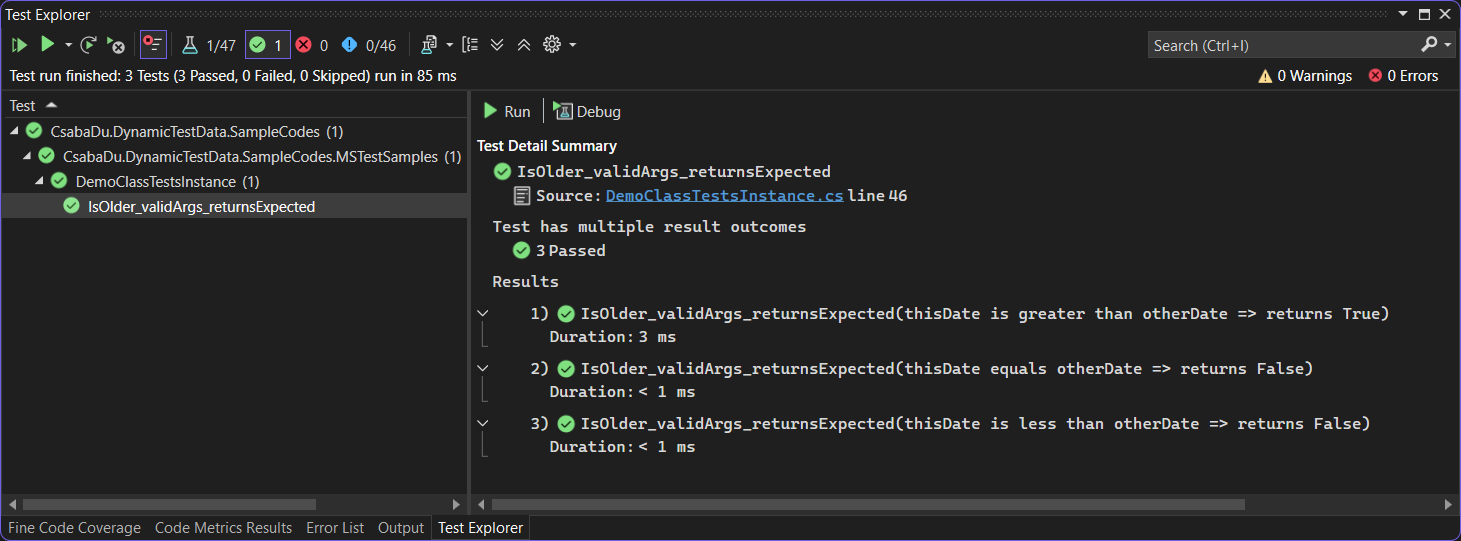
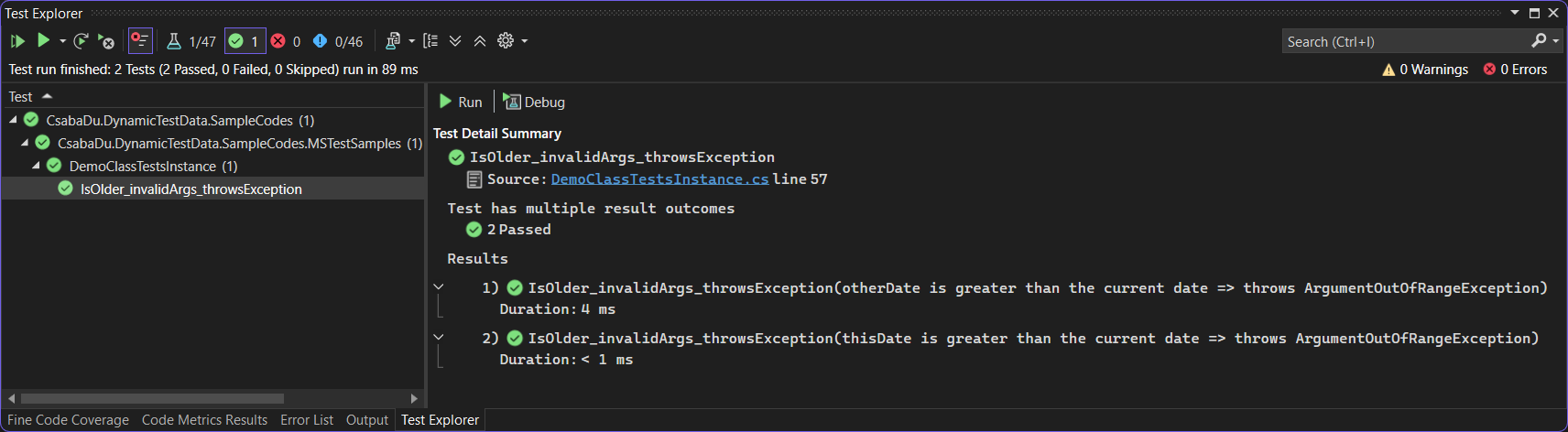
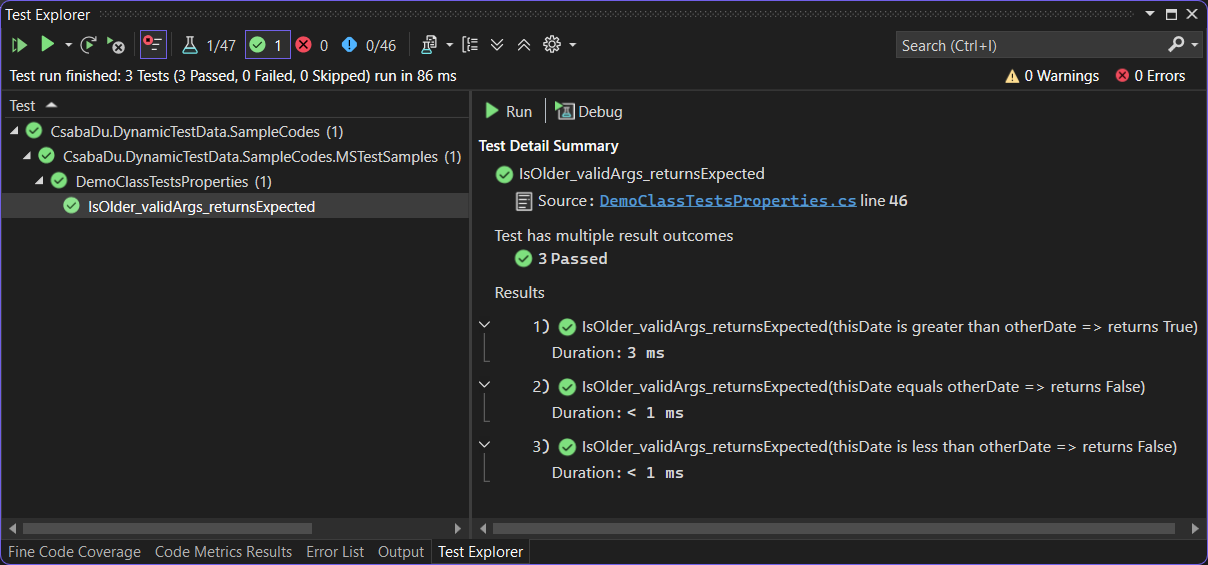
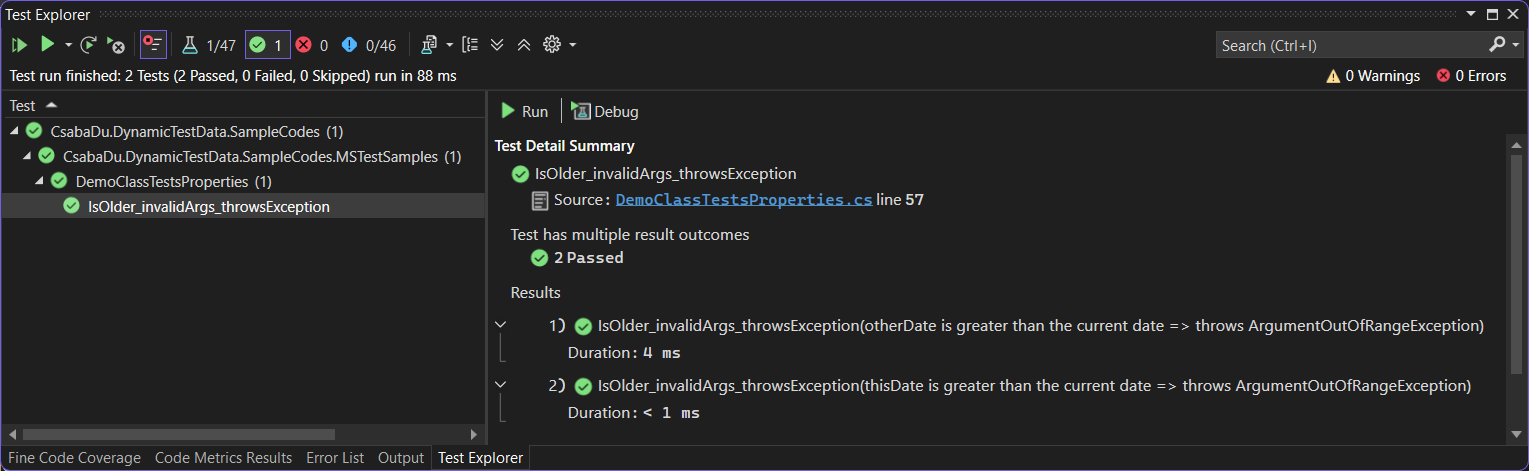
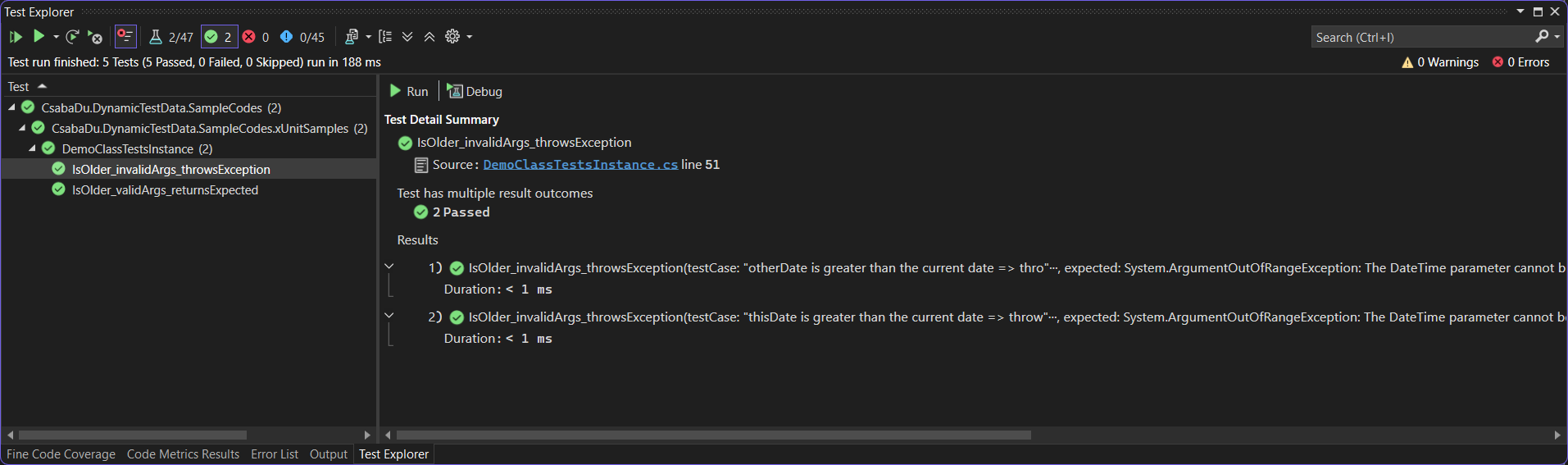
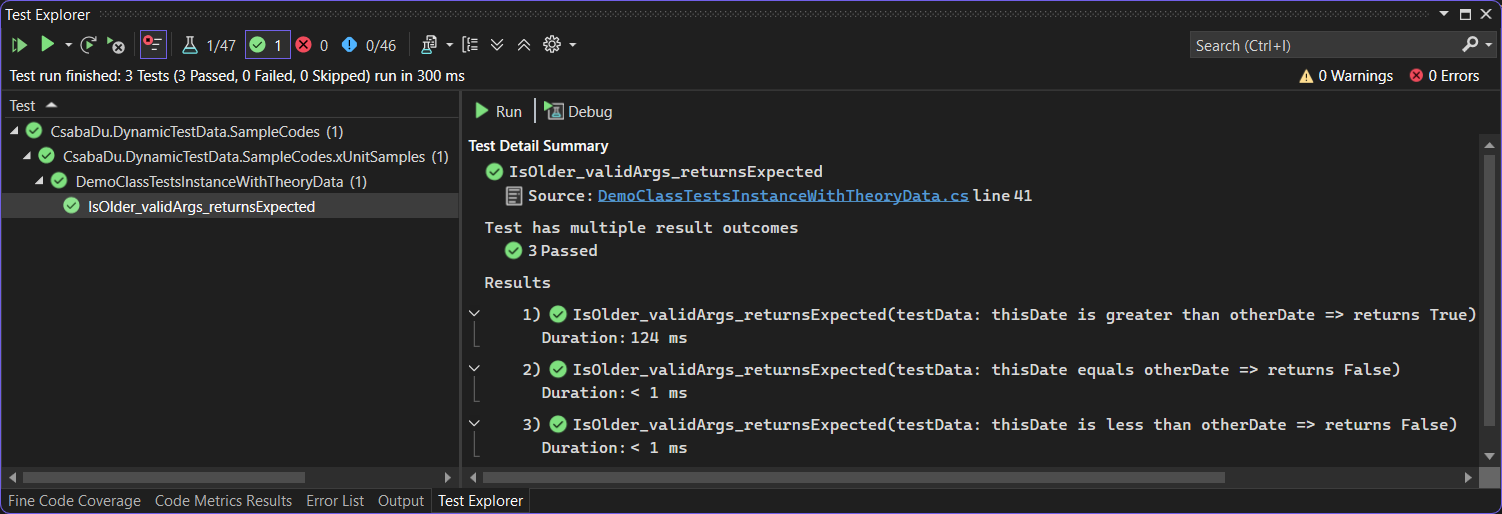
The individual test cases will be displayed in Test Explorer on the Test Details screen as multiple result outcomes. To have the short name of the test method in Test Explorer add the following xunit.runner.json file to the test project:
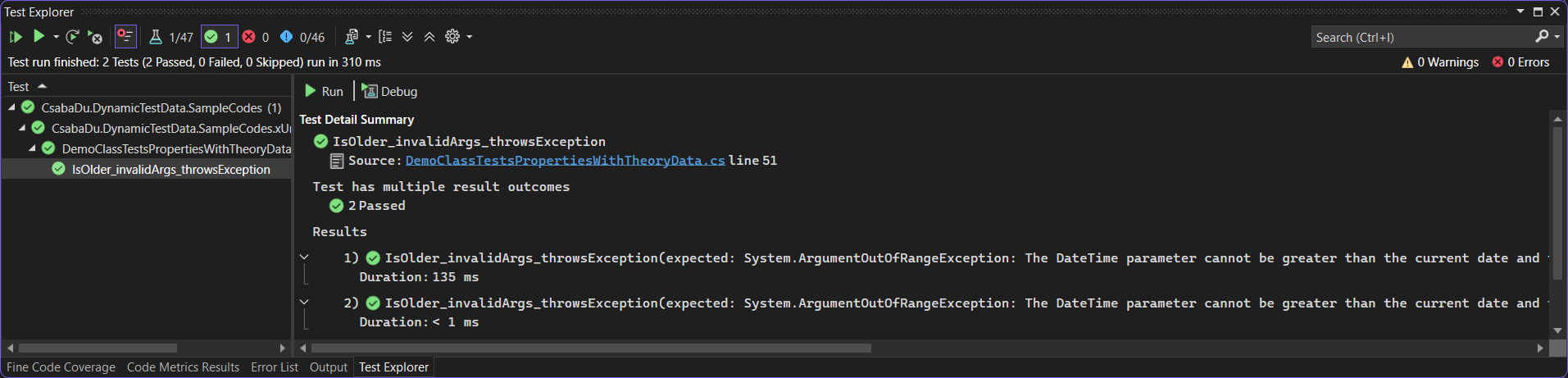
Besides, note that you can have the desired test case display name in the Test Explorer just when you use the TestData instance as the element of the generated object array, otherwise Test Explorer will display the test parameters in the default format.
Find xUnit sample codes for using TestData instance as test method parameter:
using Xunit;

namespace CsabaDu.DynamicTestData.SampleCodes.xUnitSamples;

public sealed class DemoClassTestsInstance
{
    private readonly DemoClass _sut = new();
    private static readonly NativeTestDataSource DataSource = new(ArgsCode.Instance);

    public static IEnumerable<object?[]> IsOlderReturnsArgsList
    => DataSource.IsOlderReturnsArgsToList();

    public static IEnumerable<object?[]> IsOlderThrowsArgsList
    => DataSource.IsOlderThrowsArgsToList();

    [Theory, MemberData(nameof(IsOlderReturnsArgsList))]
    public void IsOlder_validArgs_returnsExpected(TestDataReturns<bool, DateTime, DateTime> testData)
    {
        // Arrange & Act
        var actual = _sut.IsOlder(testData.Arg1, testData.Arg2);

        // Assert
        Assert.Equal(testData.Expected, actual);
    }

    [Theory, MemberData(nameof(IsOlderThrowsArgsList))]
    public void IsOlder_invalidArgs_throwsException(TestDataThrows<ArgumentOutOfRangeException, DateTime, DateTime> testData)
    {
        // Arrange & Act
        void attempt() => _ = _sut.IsOlder(testData.Arg1, testData.Arg2);

        // Assert
        var actual = Assert.Throws<ArgumentOutOfRangeException>(attempt);
        Assert.Equal(testData.Expected.ParamName, actual.ParamName);
        Assert.Equal(testData.Expected.Message, actual.Message);
    }
}
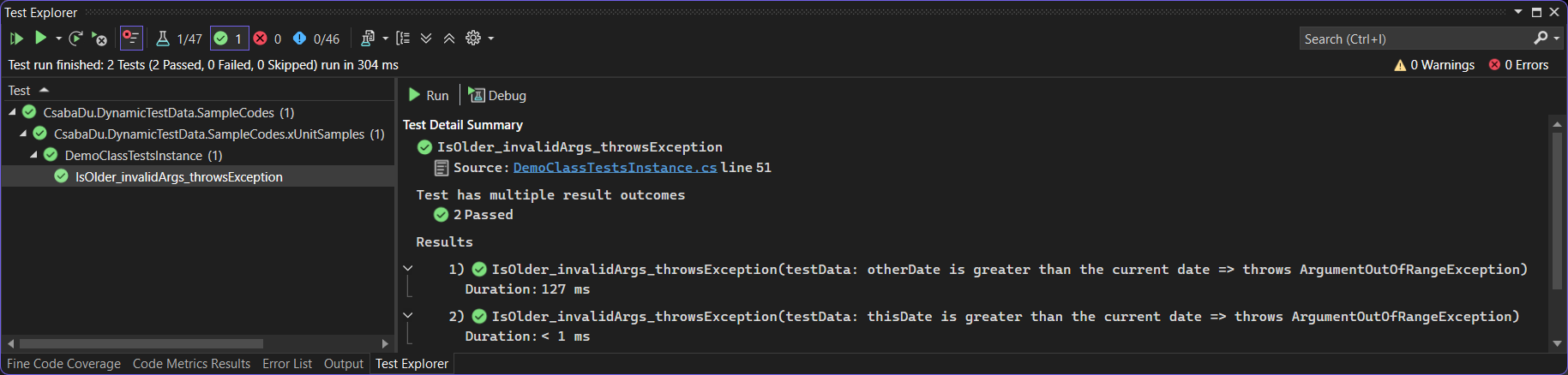
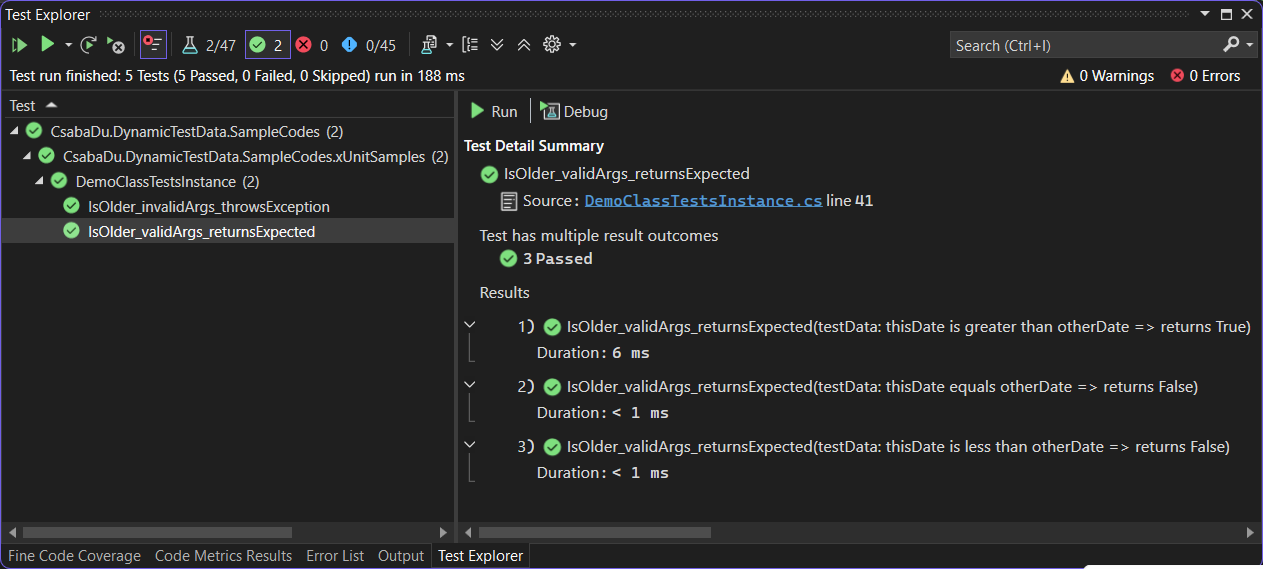
Results in the Test Explorer:
Find xUnit sample codes for using TestData properties' object array members as test method parameters.
using Xunit;

namespace CsabaDu.DynamicTestData.SampleCodes.xUnitSamples;

public sealed class DemoClassTestsProperties
{
    private readonly DemoClass _sut = new();
    private static readonly NativeTestDataSource DataSource = new(ArgsCode.Properties);

    public static IEnumerable<object?[]> IsOlderReturnsArgsList
    => DataSource.IsOlderReturnsArgsToList();

    public static IEnumerable<object?[]> IsOlderThrowsArgsList
    => DataSource.IsOlderThrowsArgsToList();

    [Theory, MemberData(nameof(IsOlderReturnsArgsList))]
    public void IsOlder_validArgs_returnsExpected(string testCase, bool expected, DateTime thisDate, DateTime otherDate)
    {
        // Arrange & Act
        var actual = _sut.IsOlder(thisDate, otherDate);

        // Assert
        Assert.Equal(expected, actual);
    }

    [Theory, MemberData(nameof(IsOlderThrowsArgsList))]
    public void IsOlder_invalidArgs_throwsException(string testCase, ArgumentOutOfRangeException expected, DateTime thisDate, DateTime otherDate)
    {
        // Arrange & Act
        void attempt() => _ = _sut.IsOlder(thisDate, otherDate);

        // Assert
        var actual = Assert.Throws<ArgumentOutOfRangeException>(attempt);
        Assert.Equal(expected.ParamName, actual.ParamName);
        Assert.Equal(expected.Message, actual.Message);
    }
}
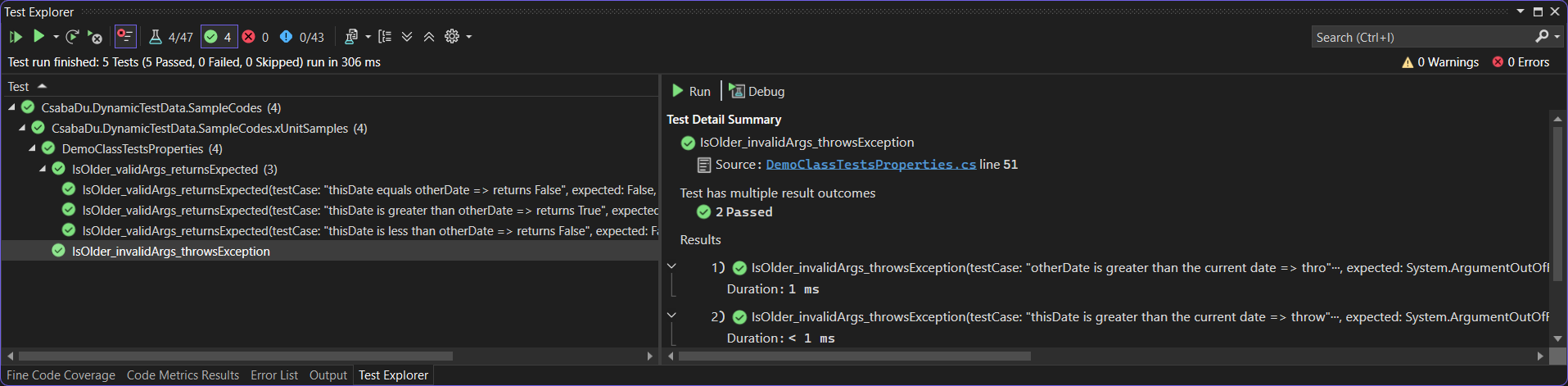
Results in the Test Explorer:
Usage of the Optional ArgsCode Parameter of the Data Source Methods
(Updated v1.2.0)
If you updated or prepared the data source methods using the OptionalToArgs method as described in the Test Framework Independent Dynamic Data Source) section, see how to override the default ArgsCode value of the initialized static data source instance of the test class. Take care with the parapeters of the respective test method(s)!
Find sample codes in xUnit for using the optional ArgsCode parameter in one of the data source methods:
using Xunit;

namespace CsabaDu.DynamicTestData.SampleCodes.xUnitSamples;

public sealed class DemoClassTestsInstance
{
    private readonly DemoClass _sut = new();
    private static readonly NativeTestDataSource DataSource = new(ArgsCode.Instance); // Default ArgsCode

    public static IEnumerable<object?[]> IsOlderReturnsArgsList
    => DataSource.IsOlderReturnsArgsToList();

    // ArgsCode Overriden
    public static IEnumerable<object?[]> IsOlderThrowsArgsList
    => DataSource.IsOlderThrowsArgsToList(ArgsCode.Properties);

    [Theory, MemberData(nameof(IsOlderReturnsArgsList))]
    public void IsOlder_validArgs_returnsExpected(TestDataReturns<bool, DateTime, DateTime> testData)
    {
        // Arrange & Act
        var actual = _sut.IsOlder(testData.Arg1, testData.Arg2);

        // Assert
        Assert.Equal(testData.Expected, actual);
    }

    // Signature of the thest method adjusted to comply with the overriden ArgsCode.
    [Theory, MemberData(nameof(IsOlderThrowsArgsList))]
    public void IsOlder_invalidArgs_throwsException(string testCase, ArgumentOutOfRangeException expected, DateTime thisDate, DateTime otherDate)
    {
        // Arrange & Act
        void attempt() => _ = _sut.IsOlder(thisDate, otherDate);

        // Assert
        var actual = Assert.Throws<ArgumentOutOfRangeException>(attempt);
        Assert.Equal(expected.ParamName, actual.ParamName);
        Assert.Equal(expected.Message, actual.Message);
    }
}
Result of the unchanged method in the Test Explorer:
Result of the method with overriden ArgsCode in the Test Explorer:
Advanced Usage
Besides generating object array lists for dynamic data-driven tests, you can use CsabaDu.DynamicTestData to support own type creation of the selected test framework.
Using TestCaseData type of NUnit
You can generate TestCaseData type of NUnit from TestData, since its constructor's parameter should be an object array. TestCaseData instances grant other features supporting meta data completion, and methods like SetName to set display name of the test case.
TheoryData is a generic type safe data source type of xUnit which implements the generic IEnumerable interface. You can use TestData types as TheoryData type parameter as well as its elements. In order to simplify the implementation, you may better use the interface ITestData generic interface types.
using CsabaDu.DynamicTestData.Statics;
using Xunit;

namespace CsabaDu.DynamicTestData.SampleCodes.DynamicDataSources;

public class TheoryDataSource(ArgsCode argsCode)
{
    protected ArgsCode ArgsCode { get; init; } = argsCode.Defined(nameof(argsCode));

    private readonly DateTime DateTimeNow = DateTime.Now;

    private DateTime _thisDate;
    private DateTime _otherDate;
    private ITestData? _testData;

    private void AddTestDataReturns(TheoryData theoryData, string definition, bool expected)
    {
        _testData = new TestDataReturns<bool, DateTime, DateTime>(definition, expected, _thisDate, _otherDate);
        AddTestData<bool>(theoryData);
    }

    private void AddTestDataThrows(TheoryData theoryData, string paramName)
    {
        _testData = new TestDataThrows<ArgumentOutOfRangeException, DateTime, DateTime>(getDefinition(), getExpected(), _thisDate, _otherDate);
        AddTestData<ArgumentOutOfRangeException>(theoryData);

        #region Local methods
        string getDefinition()
        => $"{paramName} is greater than the current date";

        ArgumentOutOfRangeException getExpected()
        => new(paramName, DemoClass.GreaterThanCurrentDateTimeMessage);
        #endregion
    }

    private void AddTestData<TResult>(TheoryData theoryData) where TResult : notnull
    {
        var testData = _testData as ITestData<TResult, DateTime, DateTime>;

        switch (ArgsCode)
        {
            case ArgsCode.Instance:
                (theoryData as TheoryData<ITestData<TResult, DateTime, DateTime>>)!.Add(testData!);
                break;
            case ArgsCode.Properties:
                (theoryData as TheoryData<TResult, DateTime, DateTime>)!.Add(testData!.Expected, testData.Arg1, testData.Arg2);
                break;
            default:
                break;
        }
    }

    public TheoryData IsOlderReturnsToTheoryData()
    {
        TheoryData? theoryData = ArgsCode switch
        {
            ArgsCode.Instance => new TheoryData<ITestData<bool, DateTime, DateTime>>(),
            ArgsCode.Properties => new TheoryData<bool, DateTime, DateTime>(),
            _ => default,
        };

        bool expected = true;
        string definition = "thisDate is greater than otherDate";
        _thisDate = DateTimeNow;
        _otherDate = DateTimeNow.AddDays(-1);
        addTestData();

        expected = false;
        definition = "thisDate equals otherDate";
        _otherDate = DateTimeNow;
        addTestData();

        definition = "thisDate is less than otherDate";
        _thisDate = DateTimeNow.AddDays(-1);
        addTestData();

        return theoryData!;

        #region Local methods
        void addTestData()
        => AddTestDataReturns(theoryData!, definition, expected);
        #endregion
    }

    public TheoryData IsOlderThrowsToTheoryData()
    {
        TheoryData? theoryData = ArgsCode switch
        {
            ArgsCode.Instance => new TheoryData<ITestData<ArgumentOutOfRangeException, DateTime, DateTime>>(),
            ArgsCode.Properties => new TheoryData<ArgumentOutOfRangeException, DateTime, DateTime>(),
            _ => default,
        };

        string paramName = "otherDate";
        _thisDate = DateTimeNow;
        _otherDate = DateTimeNow.AddDays(1);
        addTestData();

        paramName = "thisDate";
        _thisDate = DateTimeNow.AddDays(1);
        addTestData();

        return theoryData!;

        #region Local methods
        void addTestData()
        => AddTestDataThrows(theoryData!, paramName);
        #endregion
    }
}
When using TheoryData as data source type in xUnit test class, the MemberDataAttribute detects the notated test method's arguments and the compiler generates error if the constructor parameters' types and the TheoryData type parameters are different. This ensures type safety in tests when using TheoryData.
Find xUnit sample codes for using TestData instance as TheoryData element:
using Xunit;

namespace CsabaDu.DynamicTestData.SampleCodes.xUnitSamples;

public sealed class DemoClassTestsInstanceWithTheoryData
{
    private readonly DemoClass _sut = new();
    private static readonly TheoryDataSource DataSource = new(ArgsCode.Instance);

    public static TheoryData<ITestData<bool, DateTime, DateTime>> IsOlderReturnsArgsTheoryData
    => (DataSource.IsOlderReturnsToTheoryData() as TheoryData<ITestData<bool, DateTime, DateTime>>)!;

    public static TheoryData<ITestData<ArgumentOutOfRangeException, DateTime, DateTime>> IsOlderThrowsArgsTheoryData
    => (DataSource.IsOlderThrowsToTheoryData() as TheoryData<ITestData<ArgumentOutOfRangeException, DateTime, DateTime>>)!;

    [Theory, MemberData(nameof(IsOlderReturnsArgsTheoryData))]
    public void IsOlder_validArgs_returnsExpected(ITestData<bool, DateTime, DateTime> testData)
    {
        // Arrange & Act
        var actual = _sut.IsOlder(testData.Arg1, testData.Arg2);

        // Assert
        Assert.Equal(testData.Expected, actual);
    }

    [Theory, MemberData(nameof(IsOlderThrowsArgsTheoryData))]
    public void IsOlder_invalidArgs_throwsException(ITestData<ArgumentOutOfRangeException, DateTime, DateTime> testData)
    {
        // Arrange & Act
        void attempt() => _ = _sut.IsOlder(testData.Arg1, testData.Arg2);

        // Assert
        var actual = Assert.Throws<ArgumentOutOfRangeException>(attempt);
        Assert.Equal(testData.Expected.ParamName, actual.ParamName);
        Assert.Equal(testData.Expected.Message, actual.Message);
    }
}
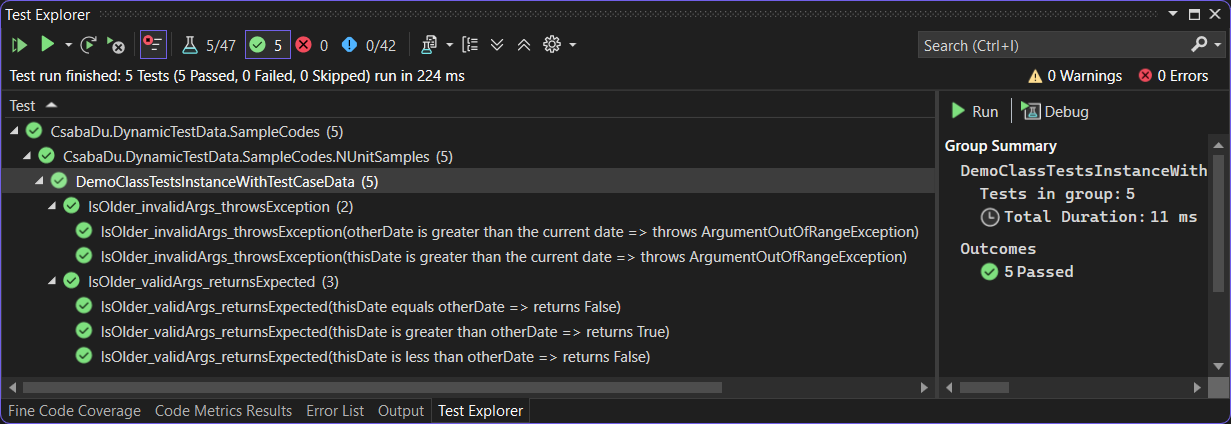
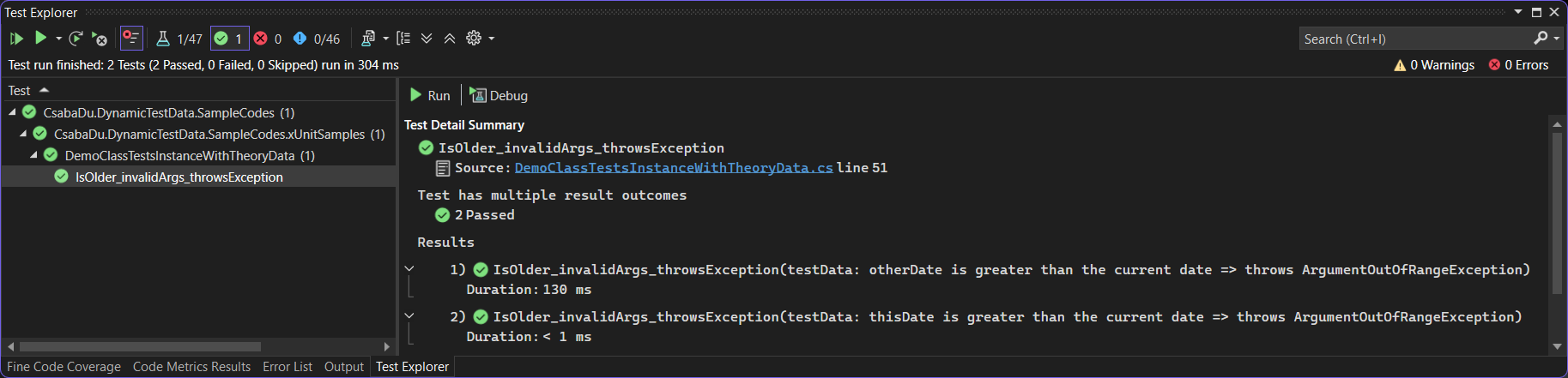
Results in the Test Explorer:
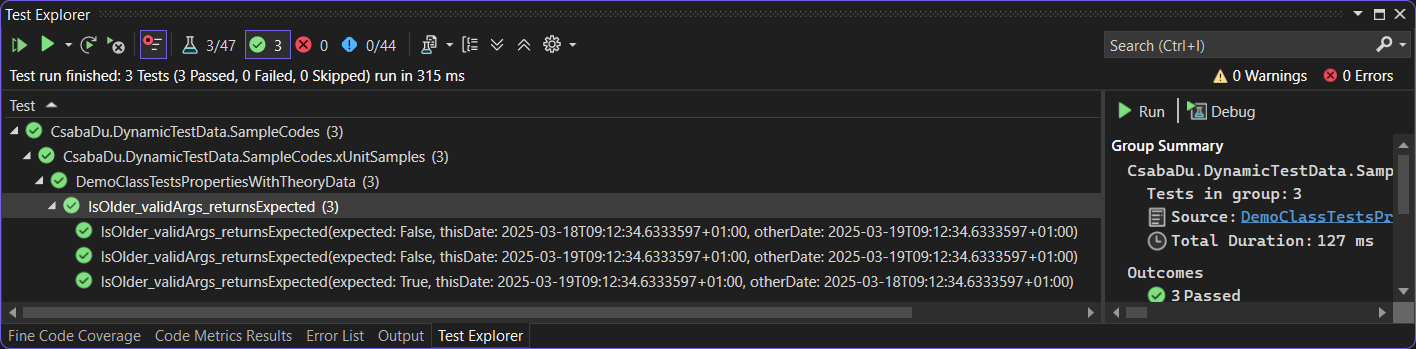
The limitations mentioned in the Usage in xUnit section are applicable here. Besides, you will detect that when TheoryData elements are intristics only, the Test Explorer will display each test case like individual test methods yet.
Find xUnit sample codes for using TestData properties as TheoryData elements:
using Xunit;

namespace CsabaDu.DynamicTestData.SampleCodes.xUnitSamples;

public sealed class DemoClassTestsPropertiesWithTheoryData
{
    private readonly DemoClass _sut = new();
    private static readonly TheoryDataSource DataSource = new(ArgsCode.Properties);

    public static TheoryData<bool, DateTime, DateTime> IsOlderReturnsArgsTheoryData
    => (DataSource.IsOlderReturnsToTheoryData() as TheoryData<bool, DateTime, DateTime>)!;

    public static TheoryData<ArgumentOutOfRangeException, DateTime, DateTime> IsOlderThrowsArgsTheoryData
    => (DataSource.IsOlderThrowsToTheoryData() as TheoryData<ArgumentOutOfRangeException, DateTime, DateTime>)!;

    [Theory, MemberData(nameof(IsOlderReturnsArgsTheoryData))]
    public void IsOlder_validArgs_returnsExpected(bool expected, DateTime thisDate, DateTime otherDate)
    {
        // Arrange & Act
        var actual = _sut.IsOlder(thisDate, otherDate);

        // Assert
        Assert.Equal(expected, actual);
    }

    [Theory, MemberData(nameof(IsOlderThrowsArgsTheoryData))]
    public void IsOlder_invalidArgs_throwsException(ArgumentOutOfRangeException expected, DateTime thisDate, DateTime otherDate)
    {
        // Arrange & Act
        void attempt() => _ = _sut.IsOlder(thisDate, otherDate);

        // Assert
        var actual = Assert.Throws<ArgumentOutOfRangeException>(attempt);
        Assert.Equal(expected.ParamName, actual.ParamName);
        Assert.Equal(expected.Message, actual.Message);
    }
}
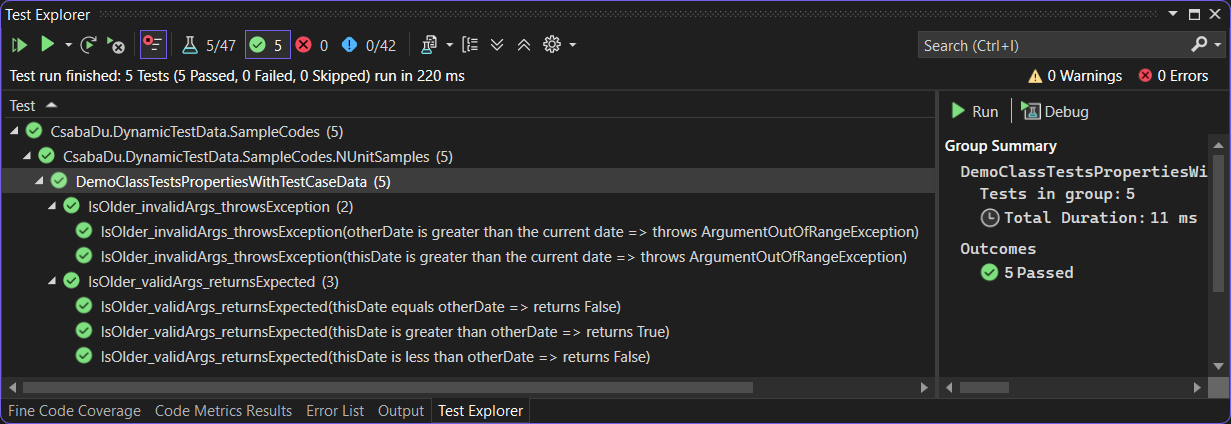
Results in the Test Explorer:
Changelog
Version 1.0.0 (2025-02-09)
Initial release of the CsabaDu.DynamicTestData framework.
Includes the ITestData generic interface types, TestData record types, DynamicDataSource base class, and ArgsCode enum.
Provides support for dynamic data-driven tests with multiple arguments, expected not null `ValueType' results, and exceptions.
Version 1.1.0 (2025-03-27)
Added:
OptionalToArgs method added to the DynamicDataSource class.
DisposableMemento private class added to the DynamicDataSource class.
ArgsCode property behavior of the DynamicDataSource class changed.
Note: This update is backward-compatible with previous versions.
Version 1.1.1 (2025-03-27)
Changed:
private DynamicDataSource._tempArgsCode to protected DynamicDataSource.tempArgsCode, to allow for easier extension of the DynamicDataSource class.
Updated:
README.md and fixed navigation anchors.
Version 1.2.0 (2025-03-28)
Added:
protected static generic WithOptionalArgsCode<> methods to the DynamicDataSource class to support the extension of using the optional ArgsCode? parameter in the derived data source classes.
Changed:
OptionalToArgs method to call a WithOptionalArgsCode<> method.
protected DynamicDataSource.tempArgsCode back to private DynamicDataSource._tempArgsCode.
Updated:
README.md and fixed navigation anchors with simplification.
Note: This update is backward-compatible with previous versions.
Version 1.2.1 (2025-04-02)
Added:
Internal test helper const string.
Updated:
README.md descriptoon of WithOptionalArgsCode<> methods in the How it Works section.
Small README.md corrections and visual refactorings.
Version 1.2.2 (2025-04-10)
Changed:
TestData refactored: ExitMode and Result properties are initialized in the constructor signature.
TestDataReturns and TestDataThrows follow this change.
Version 1.2.3 (2025-04-10)
Updated:
README.md AbstractDynamicDataSource Class section corrected.
Version 1.3.0 (2025-05-06)
Added:
ITestDataReturns and ITestDataThrows base marker interfaces.
Updated:
README.md updated and AbstractDynamicDataSource Class section corrected.
Note:
This update is backward-compatible with previous versions.
Version 1.3.1 (2025-05-08)
Changed:
TestData refactored.
Updated:
README.md corrections and visual refactorings.
Version 1.4.0 (2025-05.16)
Added:
PropertiesToArgs method added to the ITestData interface to generate an object array with the test parameters only.
Updated:
README.md updated with the new feature.
README.md corrected the meaning of the behavior of struct constraint for the TStruct type parameter of ITestDataReturns<TStruct> instances.
Note:
This update is backward-compatible with previous versions.
Version 1.5.0 (2025-05.17)
Added:
object?[] ToParams(ArgsCode argsCode, bool withExpected) method added to the ITestData interface to simpplify converting the TestData instance to a test framework defined test data type.
New IExpected interface with object GetExpected() method, which is inherited by ITestDataReturns and ITestDataThrows interfaces to enhance extensibility with accessing the Expected property value of the derived generic TestDataReturns<> or TestDataThrows<> instances from the non-generic marker interface type.
Updated:
README.md updated with the new features.
Note:
This update is backward-compatible with previous versions.
Version 1.5.1 (2025-05-17)
Updated:
README.md corrections.
Version 1.5.2 (2025-05-19)
Added:
Parameter checking of DynamicDataSource.GetDisplayName(string testMethodName, object?[] args) extended to parameter args.
ITestCase : IEquatable<ITestCase> added to segregate the string TestCase property of the inherited ITestData interface, and to make the equality of two ITestData instances comparable, based on their TestCase property.
static object?[] TestDataToParams([NotNull] ITestData testData, ArgsCode argsCode, bool withExpected, out string testCase) method added to the DynamicDataSource class to null-check the ITestData testData parameter and get the value of its string TestCase property as out-parameter.
Updated:
README.md updated with the new features and other corrections.
Note:
This update is backward-compatible with previous versions.
Contributing
License
This project is licensed under the MIT License. See the License file for details.
Contact
For any questions or inquiries, please contact CsabaDu.
FAQ
How do I install the library?
You can install it via NuGet Package Manager using Install-Package CsabaDu.DynamicTestData.
Can I install IXunitSerializable or IXunitSerializer (xUnit.v3) interfaces to support using TestData types in xUnit tests?
No, you cannot install these interfaces because TestData types are open-generic ones, and don't have parameterless constructors. Although, you can generate object array of xUnit-serializable parameters to use them in TheoryData type data sources. Besides, if your tests don't have to comply with xUnit-serializability, you can use TestData types in xUnit tests well.
Can I use the earlier implemented data source and test classes with version 1.1.0 ?
Yes, you can seamlessly use the already installed classes with the upgraded v1.1.0 of CsabaDu.DynamicTestData without the need of any change in your code. Besides, you can easily modify those to enjoy the benefits of the flexibility of this version.