C# Source Generator for Strongly-Typed Mocks and Fakes
Get Started
$ dotnet add package SatorImaging.TDoublesReadme



🇺🇸 English ❘ 🇯🇵 日本語版 ❘ 🇨🇳 简体中文版
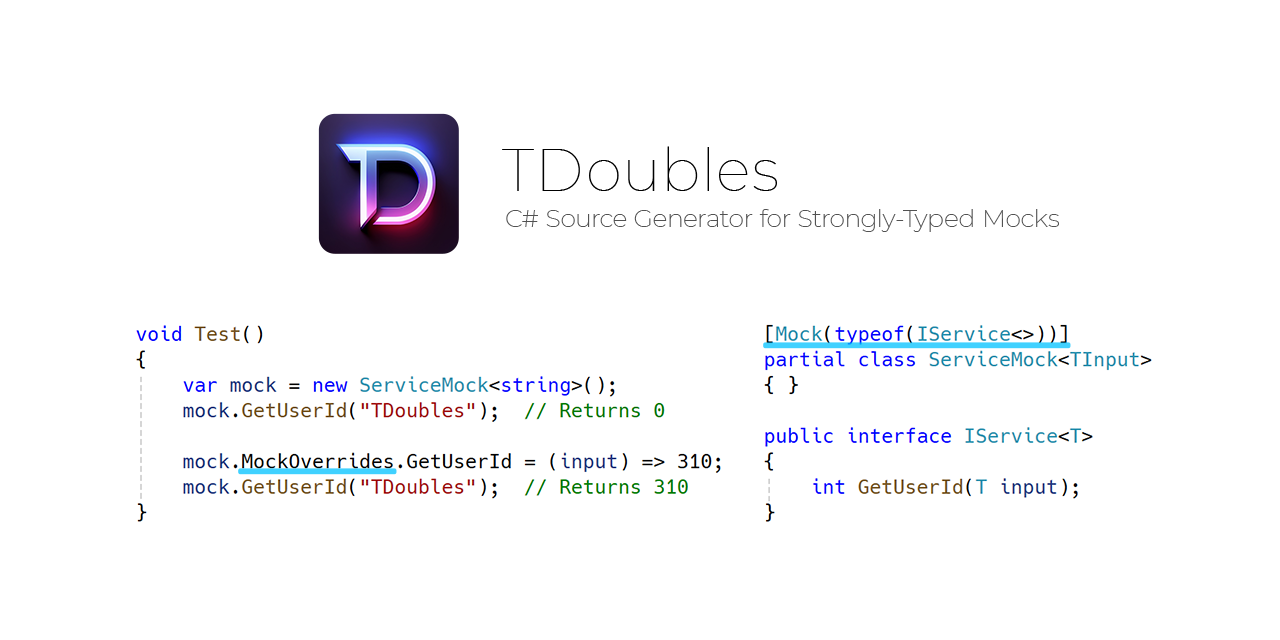
TDoubles is a powerful C# source generator that revolutionizes unit testing by creating mock wrapper classes at compile-time. Instead of relying on complex runtime reflection or proxy generation like traditional mocking frameworks, this generator produces clean, readable C# code during compilation that wraps your target types with customizable behavior.
✨ Comparison with Traditional Mocking Frameworks
| Feature | TDoubles | Traditional Frameworks (Moq, NSubstitute) |
|---|---|---|
| Performance | Zero runtime overhead, compile-time generation | Runtime reflection and proxy creation |
| Type Safety | Full compile-time checking and IntelliSense | Runtime configuration, limited IntelliSense |
| Generic Support | Full support including constraints | Limited generic type support |
| Setup Complexity | Single attribute, minimal configuration | Complex fluent APIs and setup expressions |
| Debugging | Generated code is readable and debuggable | Proxy objects can be difficult to debug |
⚡ Quick Start
Apply the [Mock] attribute to a partial class, and the generator handles the rest.
using TDoubles;

public interface IDataService
{
    string GetData(int id);
    void SaveData(string data);
}

[Mock(typeof(IDataService))]   // 👈
partial class DataServiceMock
{
    // Implementation will be generated automatically
}
Here shows how to use the mock in your code.
// Create the mock
var mockService = new DataServiceMock();

// Override behavior for testing
mockService.MockOverrides.GetData = (id) => $"MockData_{id}";
//          ~~~~~~~~~~~~~

string mockData = mockService.GetData(123); // Returns "MockData_123"
You can delegate to real implementation and override partial behaviour of the mock.
var mock = new DataServiceMock(new ConcreteDataService());

// Use default behavior (delegates to real service)
var realData = mock.GetData(123);

// Override partial behaviour for testing
mock.MockOverrides.SaveData = (data) => Console.WriteLine($"Saved: {data}");
mock.SaveData(realData);
Implements fake behaviors for debugging purposes in conjunction with latest update to the real implementation.
[Mock(typeof(IFoo), nameof(IFoo.Save), nameof(IFoo.Load))]
partial class FooFake
{
    public void Save() => File.WriteAllText("...", JsonUtility.ToJson(this, true));
    public void Load() => JsonUtility.FromJsonOverwrite(File.ReadAllText("..."), this);
}

// Delegates to latest ConcreteFoo implementation except for Save and Load
var fake = new FooFake(new ConcreteFoo());
Generic Type Support
TDoubles provides support for generic type mocking on both unbound and closed constructed generics.
[Mock(typeof(IList<int>))]
partial class ListIntMock {}

// Proper type constraint for TKey is automatically generated and
// type parameter naming mismatch is also resolved
[Mock(typeof(IDictioanry<,>))]
partial class DictionaryMock<T, U> {}
Efficient Callback Support
There are efficient extension points to implement custom callback for each mock member call.
[!TIP] As C# specification,
partial voidmethod call is completely removed from built assembly when method body is not implemented in your mock class declaration.https://learn.microsoft.com/en-us/dotnet/csharp/language-reference/keywords/partial-member
[Mock(typeof(IList<>))]
partial class ListSpy<T>  // 🕵 < Investigate suspects!
{
    readonly Dictionary<string, int> _callCountByName = new();

    // Without allocating object?[] instance
    partial void OnWillMockCall(string memberName)
    {
        if (!_callCountByName.TryGetValue(memberName, out var current))
        {
            current = 0;
        }
        _callCountByName[memberName] = current + 1;
    }

    // Another overload can take arguments passed to mock member
    // * Array.Empty<object>() is used for parameterless members
    partial void OnWillMockCall(string memberName, object?[] args)
    {
        // How to determine method overload
        if (memberName == "Add")
        {
            if (args[0] is T)
            {
                Console.WriteLine("Add(T item) is invoked.");
            }
            else
            {
                Console.WriteLine("Add(object item) is invoked.");
            }
        }
    }
}
Mock Attribute Options
There are options to select generated mock members.
// Include internal types, interfaces and members to mock generation
[Mock(typeof(Foo), IncludeInternals = true)]
partial class FooMock { }

// Exclude specified members from mock generation (no error if member is not found)
[Mock(typeof(Foo), "ToString", "Foo", "Bar", IncludeInternals = false)]
partial class FooMockWithoutToStringOverride
{
    // You can re-implement excluded 'ToString' as you desired
    public override string ToString() => base.ToString() ?? "<NULL>";
}
Introduction
The generator works by analyzing types marked with the [Mock] attribute and generating corresponding mock classes that delegate to the original implementation while providing override capabilities through a simple, strongly-typed API. This approach eliminates the performance overhead of reflection-based mocking while maintaining full type safety and IntelliSense support.
Key Benefits
- Zero Runtime Overhead: Mock classes are generated at compile-time, eliminating reflection costs and improving test execution performance
- Full Type Safety: Generated mocks provide complete IntelliSense support, compile-time checking, and refactoring safety
- Minimal Setup: Simply add the NuGet package, apply the
[Mock]attribute to a partial class, and the generator handles the rest - Universal Compatibility: Supports all major C# type constructs including interfaces, classes, records, record structs, regular structs, and static classes
- Advanced Generic Support: Handles complex generic scenarios including type constraints, nested generics, and generic method overloads
- Internal Member Access: Optional
IncludeInternalsconfiguration allows mocking of internal members for comprehensive testing - Clean Generated Code: Produces human-readable, debuggable mock implementations that integrate seamlessly with your codebase
Use Cases
TDoubles generator excels in scenarios where you need:
- High-Performance Testing: When test execution speed is critical and reflection overhead is unacceptable
- Legacy Code Testing: Mocking existing classes and structs that weren't designed with interfaces
- Static Method Testing: Converting static methods to testable instance methods through mock wrappers
- Record and Struct Mocking: Testing value types and immutable records that traditional frameworks struggle with
- Complex Generic Testing: Mocking generic types with multiple type parameters and constraints
- Internal API Testing: Testing internal members without making them public
How It Works
- Mark Target Types: Apply the
[Mock(typeof(TargetType))]attribute to a partial class - Compile-Time Generation: The source generator analyzes your target type and creates a mock implementation
- Delegate with Overrides: Generated mocks delegate to the original instance while providing
MockOverridesfor custom behavior - Test with Confidence: Use the generated mock in your tests with full type safety and performance
Delegation Logic
Here is pseudo code of delegation. Actual code is more complicated as need to support ref and out parameter modifiers.
public string GetData(int id)
{
    // Returns 'default' if value type or nullable reference type otherwise throws
    return MockOverrides.GetData?.Invoke(id)
        ?? _target?.GetData(id)
        ?? throw new TDoublesException(...);
}
Generated Mock Structure
When you create a mock class, the generator adds several members:
[Mock(typeof(IUserService))]
partial class UserServiceMock
{
    // Generated by source generator:

    // Constructor that takes the target instance
    public UserServiceMock(IUserService? target = default) { }

    // Access to the underlying target
    public IUserService? MockTarget { get; }

    // Unified callback
    partial void OnWillMockCall(string memberName);
    partial void OnWillMockCall(string memberName, object?[] args);

    // Override configuration object
    public sealed class MockOverrideContainer { }
    public MockOverrideContainer MockOverrides { get; }

    // All interface/class members are implemented
    public string GetUserName(int userId) { /* generated implementation */ }
    public Task<bool> DeleteUser(int userId) { /* generated implementation */ }
    // ... etc
}
Installation
NuGet Package Installation
Package Manager Console
Install-Package SatorImaging.TDoubles
.NET CLI
dotnet add package SatorImaging.TDoubles
PackageReference (Manual)
Add the following to your project file (.csproj):
<PackageReference Include="SatorImaging.TDoubles" Version="1.0.0" />
System Requirements
- .NET Framework: .NET Standard 2.0 or higher
- C# Language Version: C# 7.3 or later
- Compatible Runtimes:
- .NET Framework 4.6.1+
- .NET Core 2.0+
- .NET 5.0+
- Unity 2022.3.12f1 or later
Setup and Configuration
Basic Setup
- Install the NuGet package using one of the methods above
- Rebuild your project to enable the source generator
- Create partial classes with the
[Mock]attribute to generate mocks
Project Configuration
No additional project configuration is required. The source generator automatically activates when the package is installed and will generate mock classes during compilation.
Verification
To verify the installation was successful:
- Add a simple mock class to your project:
using TDoubles; public interface ITestService { string GetMessage(); } [Mock(typeof(ITestService))] partial class TestServiceMock { // Mock implementation will be generated here } - Build your project
- Check that no compilation errors occur and the mock class is generated
IDE Support
- Visual Studio: Full IntelliSense support for generated mock classes
- Visual Studio Code: Works with C# extension
- JetBrains Rider: Full support with code completion
- Command Line: Works with
dotnet buildandmsbuild
Basic Usage
This section provides step-by-step examples to get you started with TDoubles. All examples are complete and ready to use in your projects.
Prerequisites
Before using the TDoubles generator, ensure your mock classes meet these requirements:
- Partial Class: Mock classes must be declared as
partial - Mock Attribute: Apply
[Mock(typeof(TargetType))]to the partial class - Namespace: Include
using TDoubles; - Visibility: Use any visibility modifier (public, internal, etc.) - generated members will inherit the same visibility
Simple Interface Mocking
The most common scenario is mocking interfaces for dependency injection testing.
Example: User Service Interface
using TDoubles;
using System;
using System.Threading.Tasks;

// Define your interface
public interface IUserService
{
    string GetUserName(int userId);
    Task<bool> DeleteUser(int userId);
    bool IsUserActive(int userId);
}

// Create a partial mock class
[Mock(typeof(IUserService))]
partial class UserServiceMock
{
    // The source generator will create the complete implementation here
}

// Example usage in tests
class Program
{
    static void Main()
    {
        // Create a concrete implementation for delegation
        var realService = new ConcreteUserService();

        // Create the mock with the real service as the underlying target
        var mockService = new UserServiceMock(realService);

        Console.WriteLine("=== Default Behavior (Delegates to Real Service) ===");
        Console.WriteLine($"User Name: {mockService.GetUserName(123)}");
        Console.WriteLine($"Is Active: {mockService.IsUserActive(123)}");

        Console.WriteLine("\n=== Custom Behavior with Overrides ===");

        // Override specific methods for testing
        mockService.MockOverrides.GetUserName = (userId) => $"MockUser_{userId}";
        mockService.MockOverrides.IsUserActive = (userId) => userId > 100;

        Console.WriteLine($"User Name (Overridden): {mockService.GetUserName(123)}");
        Console.WriteLine($"Is Active (Overridden): {mockService.IsUserActive(50)}");
        Console.WriteLine($"Is Active (Overridden): {mockService.IsUserActive(150)}");

        // Access the underlying real service if needed
        Console.WriteLine($"Real Service: {mockService.MockTarget.GetUserName(123)}");
    }
}

// Concrete implementation for demonstration
public class ConcreteUserService : IUserService
{
    public string GetUserName(int userId) => $"RealUser_{userId}";
    public async Task<bool> DeleteUser(int userId) => await Task.FromResult(true);
    public bool IsUserActive(int userId) => true;
}
Class Mocking with Inheritance
Mock concrete classes to test inheritance scenarios and virtual method overrides.
Example: Service Class with Virtual Methods
using TDoubles;
using System;

// Base service class with virtual methods
public class DatabaseService
{
    public virtual string GetConnectionString() => "Server=localhost;Database=prod;";
    public virtual void SaveData(string data) => Console.WriteLine($"Saving to database: {data}");
    public virtual int GetRecordCount() => 1000;

    // Non-virtual method (will be wrapped but not overridable)
    public string GetServiceName() => "DatabaseService";
}

// Create mock for the class
[Mock(typeof(DatabaseService))]
partial class DatabaseServiceMock
{
    // Generated implementation will wrap all public methods
}

// Example usage
class Program
{
    static void Main()
    {
        // Create real service instance
        var realService = new DatabaseService();

        // Create mock wrapper
        var mockService = new DatabaseServiceMock(realService);

        Console.WriteLine("=== Default Behavior ===");
        Console.WriteLine($"Connection: {mockService.GetConnectionString()}");
        Console.WriteLine($"Service Name: {mockService.GetServiceName()}");
        Console.WriteLine($"Record Count: {mockService.GetRecordCount()}");
        mockService.SaveData("test data");

        Console.WriteLine("\n=== Testing Scenario Overrides ===");

        // Override for testing scenarios
        mockService.MockOverrides.GetConnectionString = () => "Server=testserver;Database=test;";
        mockService.MockOverrides.GetRecordCount = () => 0; // Simulate empty database
        mockService.MockOverrides.SaveData = (data) => Console.WriteLine($"TEST MODE: Would save '{data}'");

        Console.WriteLine($"Test Connection: {mockService.GetConnectionString()}");
        Console.WriteLine($"Test Record Count: {mockService.GetRecordCount()}");
        mockService.SaveData("test data");

        // Non-virtual methods still work but delegate to original
        Console.WriteLine($"Service Name (always delegates): {mockService.GetServiceName()}");
    }
}
Inheritance and Interface Implementation
Mock classes that both inherit from base classes and implement interfaces.
Example: Complex Service Hierarchy
using TDoubles;
using System;

// Interface definition
public interface INotificationService
{
    void SendNotification(string message);
    bool IsServiceAvailable();
}

// Base class with virtual methods
public class BaseService
{
    public virtual string GetServiceType() => "Base";
    public virtual void Initialize() => Console.WriteLine("Base initialization");
}

// Concrete class that inherits and implements interface
public class EmailService : BaseService, INotificationService
{
    public override string GetServiceType() => "Email";
    public override void Initialize() => Console.WriteLine("Email service initialized");

    public void SendNotification(string message) => Console.WriteLine($"Email: {message}");
    public bool IsServiceAvailable() => true;
}

// Mock the concrete class
[Mock(typeof(EmailService))]
partial class EmailServiceMock
{
    // Mocks both inherited methods and interface implementations
}

// Usage example
class Program
{
    static void Main()
    {
        var realService = new EmailService();
        var mockService = new EmailServiceMock(realService);

        Console.WriteLine("=== Testing Inherited Methods ===");
        Console.WriteLine($"Service Type: {mockService.GetServiceType()}");
        mockService.Initialize();

        Console.WriteLine("\n=== Testing Interface Methods ===");
        mockService.SendNotification("Hello World");
        Console.WriteLine($"Available: {mockService.IsServiceAvailable()}");

        Console.WriteLine("\n=== Testing with Overrides ===");

        // Override inherited method
        mockService.MockOverrides.GetServiceType = () => "MockEmail";
        mockService.MockOverrides.Initialize = () => Console.WriteLine("Mock initialization");

        // Override interface methods
        mockService.MockOverrides.SendNotification = (msg) => Console.WriteLine($"MOCK EMAIL: {msg}");
        mockService.MockOverrides.IsServiceAvailable = () => false;

        Console.WriteLine($"Service Type: {mockService.GetServiceType()}");
        mockService.Initialize();
        mockService.SendNotification("Test Message");
        Console.WriteLine($"Available: {mockService.IsServiceAvailable()}");
    }
}
Advanced Usage
For advanced scenarios including generic types, static classes, records, structs, and internal member access, see the Advanced Usage Guide.
Testing Examples
For comprehensive testing examples with MSTest, NUnit, and performance comparisons, see the Testing Examples Guide.
Technical Note
record and record struct
- Always implements
IEquatable<MOCK_TARGET_RECORD>andMockOverrides.MockTargetRecord_Equals- Note that it is NOT
IEquatable<GENERATED_MOCK>
- Note that it is NOT
bool Equals(object?)cannot be overridden
Known Limitations and Unsupported Scenarios
Type Parameters of Generic Method
When method uses method-level type parameter instead of type-level parameter, MockOverrides will use object instead of method-level type parameter.
// Generated mock has type-level parameter T
partial class Mock<T>
{
    // Generated mock method that has T and TMethod type parameter
    public TMethod GenericMethod<T, TMethod>(T input) { ... }

    // <TMethod> can be added to this class but it must also be exposed as type-level parameter...
    public sealed class MockOverrideContainer
    {
        // type-level parameter T is used but TMethod is shadowed to object
        public Func<T, object> GenericMethod { get; set; }
        //             ~~~~~~ Not TMethod
    }
}
[!NOTE] Generated mock method returns
TMethodas mock target does. Internally, mock method will castobjectresult from override toTMethodwhen returning value.
Type System Limitations
Unsupported Types:
- Enums (use wrapper classes instead)
- Delegates and function pointers
- Primitive types (
int,string, etc.) - Static classes with only static constructors
- Abstract classes with pure virtual methods requiring implementation
object,ValueType,Enumand other special types such asSpan<T>
Type Constraint Limitations
Unsupported Constraints:
where T : defaultwhere T : allows ref struct
Return Type Limitations
Unsupported Type:
refreturn type
Attribute Limitations
Attributes on type, method, property or etc are not preserved in generated mock.
Method and Property Limitations
Unsupported Members:
refandoutparameters in some complex scenarios (?)Methods with__arglist(variable arguments)Explicit interface implementations with name conflictsProperties with complex getter/setter accessibility combinations
Partial Support:
public interface IService
{
    // ✅ Fully supported
    string GetData(int id);
    Task<bool> ProcessAsync(string data);

    // ⚠️ Limited support - may not override correctly
    ref int GetReference();
    void ProcessData(__arglist);
}
Generic Method Limitations
Some valid type constraint is not transformed correctly. We have no plan to support this edge case of type constraint.
Note:
overridemethod cannot have type constraint except forclassandstruct.
// Abstract method declaration that returns (M, N?) with where M : N? constraint
public abstract (M t, N? u) TypeArgMappingNullable_Abstract<M, N>() where M : N?;

// Expected (valid) return type is (M, N)
public override (M t, N u) TypeArgMappingNullable_Abstract<M, N>() { }

// But got (M, N?)
public override (M t, N? u) TypeArgMappingNullable_Abstract<M, N>() { }
Inheritance and Interface Limitations
Multiple Interface Implementation:
Supported, but explicit interface implementations may have naming conflicts- Diamond inheritance patterns may cause method resolution issues
Virtual Method Overriding:
Onlyvirtualandabstractmethods can be overridden in class mockssealedmethods cannot be overridden (will delegate to original)
Platform and Framework Limitations
Framework Support:
- Requires .NET Standard 2.0 or higher
- Source generators require C# 7.3 or later
- Some advanced C# 11+ features may not be fully supported
IDE Integration:
- IntelliSense may be delayed for newly generated mocks
- Some IDEs may require rebuild to recognize generated code
- Debugging generated code may show optimized/synthetic code
Contributing
We welcome and appreciate contributions from the community! Whether you're fixing bugs, adding features, improving documentation, or providing feedback, your contributions help make TDoubles better for everyone.
See CONTRIBUTING.md
Code of Conduct
We are committed to providing a welcoming and inclusive environment for all contributors. Please be respectful and professional in all interactions.
Support and Community
Getting Help
If you encounter issues not covered in this troubleshooting guide:
- Check the GitHub Issues: Search existing issues for similar problems
- Create a Minimal Reproduction: Provide the smallest possible code example that demonstrates the issue
- Include Build Output: Share relevant compiler errors and warnings
- Specify Environment: Include .NET version, IDE, and operating system details
Support Channels:
- GitHub Discussions - Questions and community support
- GitHub Issues - Bug reports and feature requests
Reporting Security Issues
If you discover a security vulnerability, please report it privately by emailing the maintainers rather than creating a public issue. This allows us to address the issue before it becomes widely known.
Project Information
TODO: Help Wanted
- Missing Tests
staticclass mockingsealedoverridden methodsasynctestseventgetter and setter testsreadonly structtestsreadonly record structtestsTupleandValueTupletests- Property and indexer accessibility tests (e.g.,
{ get; private set; }or etc)
- Missing Features
refreturn- Attribute preservation
- Support for nested types (e.g.,
[Mock(typeof(Foo.Bar))]) - Nested generic type mocking (e.g.,
[Mock(typeof(Foo.NestedKeyValueStore<,>))]) - Add proper
<inheritdoc cref="..." />for mock members - Support for
defaultandallows ref structtype constraint- The
defaultconstraint is valid on override and explicit interface implementation methods only - Roslyn update is required while keeping Unity engine support
- The
- Emit diagnostic error on type parameters
- Optimization
- Use
ImmutableArray<T>orImmutableList<T>as possible - Eliminate inefficient
StringBuilderuse
- Use
- Refactor
- Eliminate FP programming techniques
- Transform data model to domain model to encapsulate information and behaviour
- Centralize blueprint-to-C# conversion in domain model to make it consistent, robust and maintainable
- Eliminate duplicate functions, control flows and etc scattered in codebase
- Eliminate FP programming techniques
- Optional
NewMockattribute option to generateMockCallCountsthat records the call count of each mock member- Declare
volatile intfields - Increment count by
Interlocked.Increment(ref ...)method at the beginning of generated mock class member.
- Declare
Author and Maintainer
Sator Imaging
- GitHub: @sator-imaging
- Project Repository: sator-imaging/TDoubles
Acknowledgments
We thank all contributors who have helped improve this project through code contributions, bug reports, feature suggestions, and community support.
License
This project is licensed under the MIT License.
Third-Party Licenses
This project uses the following third-party packages:
- Microsoft.CodeAnalysis.CSharp (MIT License)
- Microsoft.CodeAnalysis.Analyzers (MIT License)
© 2025 Sator Imaging. All rights reserved.
For support, questions, or contributions, please visit our GitHub repository.