Performance utilities for .NET projects, including the MemoryStreamSlim, StringBuilderCache, InterlockedOps, and Compression classes.
Get Started
$ dotnet add package KZDev.PerfUtilsReadme
KZDev.PerfUtils
The KZDev.PerfUtils package provides the following high-performance utility classes:
MemoryStreamSlim: A high-performance, memory-efficient, and easy-to-use replacement for the MemoryStream class, offering significant performance benefits for large or frequently used streams.StringBuilderCache: A thread-safe cache of StringBuilder instances to improve speed and reduce the overhead of memory allocations associated with the StringBuilder class.InterlockedOps: A utility that extends the functionality of the Interlocked class in the .NET Class Library by providing additional atomic thread-safe operations.
Performance Highlights
This sampling of performance benchmarks clearly demonstrates the advantages of using the KZDev.PerfUtils package:
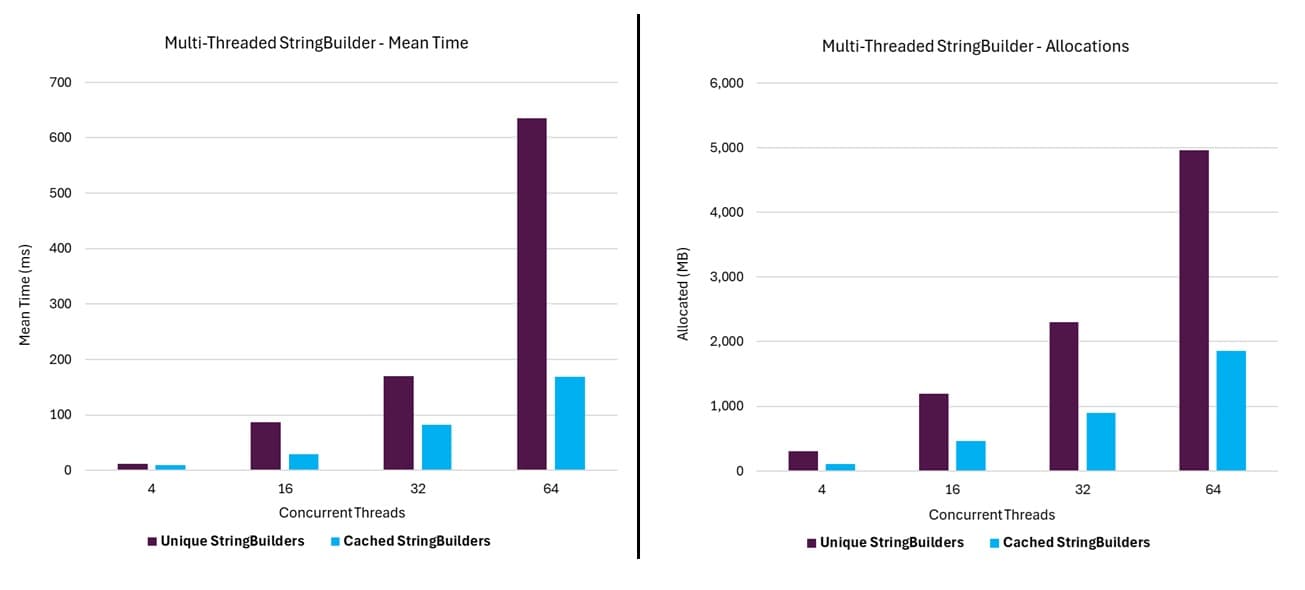

For more details, refer to the benchmark related pages in the documentation.
Features
MemoryStreamSlim
MemoryStreamSlim is a drop-in replacement for the MemoryStream class, offering the following benefits:
- Improved Throughput: Outperforms the standard MemoryStream.
- Reduced Memory Traffic: Significantly lowers memory traffic and garbage collection compared to the standard MemoryStream.
- Eliminates LOH Fragmentation: Prevents Large Object Heap (LOH) fragmentation caused by frequent use and release of single-byte arrays.
- API Compatibility: Provides the same API as MemoryStream, with minor differences in the constructor.
- Optional Native Memory Storage: Allows the use of native memory for storage, further reducing GC pressure and increasing flexibility.
- Outperforms Similar Libraries: Compared to other libraries like RecyclableMemoryStream, it is designed to be easier to use, more flexible, and incurs fewer memory allocations and garbage collections.
StringBuilderCache
StringBuilderCache is a static class that provides a thread-safe cache of StringBuilder instances, reducing allocations and deallocations in high-throughput scenarios. Key features include:
- Acquire: Retrieve a StringBuilder instance from the cache.
- Release: Return a StringBuilder instance to the cache.
- GetStringAndRelease: Retrieve the string from a StringBuilder instance and return it to the cache.
- GetScope: Use a using-scoped StringBuilder instance, which is automatically returned to the cache when the scope is exited.
- Monitoring: Leverages the .NET runtime's Events feature for detailed cache management and monitoring.
InterlockedOps
InterlockedOps is a static class that provides additional thread-safe atomic operations for integer types, including:
- Xor: Perform an exclusive OR operation.
- ClearBits: Clear specific bits.
- SetBits: Set specific bits.
- ConditionAnd: Conditionally update bits using an AND operation.
- ConditionOr: Conditionally update bits using an OR operation.
- ConditionXor: Conditionally update bits using an XOR operation.
- ConditionClearBits: Conditionally clear specific bits.
- ConditionSetBits: Conditionally set specific bits.
Examples
MemoryStreamSlim Example
Below is an example of how to use the MemoryStreamSlim class. Other than instantiation using the Create method, the API is identical to the standard MemoryStream class. Note that it is always a best practice to dispose of the MemoryStreamSlim instance when it is no longer needed.
using KZDev.PerfUtils;

// Create a new MemoryStreamSlim instance
// For the best management of the memory buffers, it is very important to
// dispose of the MemoryStreamSlim instance when it is no longer needed.
using (MemoryStreamSlim stream = MemoryStreamSlim.Create())
{
        // Write some data to the stream
        stream.Write(new byte[] { 1, 2, 3, 4, 5 }, 0, 5);

        // Read the data back from the stream
        stream.Position = 0;
        byte[] buffer = new byte[5];
        stream.Read(buffer, 0, 5);
}
StringBuilderCache Example
Below is an example of how to use the StringBuilderCache class to acquire a StringBuilder instance, append strings to it, and then release it back to the cache. The GetStringAndRelease method is used to retrieve the string and release the StringBuilder instance back to the cache.
using KZDev.PerfUtils;

class Program
{
    static void Main()
    {
        StringBuilder stringBuilder = StringBuilderCache.Acquire();
        stringBuilder.Append("Hello, ");
        stringBuilder.Append("World!");
        Console.WriteLine(StringBuilderCache.GetStringAndRelease(stringBuilder));
    }
}
InterlockedOps Example
Below is an example of how to use the InterlockedOps class to perform an atomic XOR operation on an integer variable. The Xor method toggles a bit flag between 1 and 0 in a thread-safe manner and returns a boolean value indicating whether the bit flag was set to 1.
using KZDev.PerfUtils;

public class XorExample
{
    private int _flag;

    public bool ToggleFlag ()
    {
        int originalValue = InterlockedOps.Xor(ref _flag, 1);
        return originalValue == 0;
    }
}
Compare to RecyclableMemoryStream
The MemoryStreamSlim class is conceptually similar to the RecyclableMemoryStream class from Microsoft. However, the internal implementation of buffer management is quite different. Compared to RecyclableMemoryStream, the MemoryStreamSlim class is designed to:
- Easier to use without requiring parameter tuning.
- More flexible across a broad range of use cases.
- Fewer memory allocations and garbage collections.
- Consistent performance across workloads.
- Security-first design with opt-out zeroing of unused memory.
- Automatic memory trimming and release.
- Supports .NET Metrics and Events for monitoring.
- Optionally uses native memory to avoid GC pressure.
Performance comparisons are also available in the benchmarks documentation section.
Documentation
Comprehensive documentation for the package is available on the PerfUtils Documentation page.
Future Features
The roadmap for this package includes plans to add additional performance-focused utilities as time permits.