Command Query Separation for Azure Functions ⚡ ✔️ Provides generic function support for commands and queries with HTTPTriggers ✔️ Enables APIs based on HTTP POST and GET 📄 https://hlaueriksson.me/CommandQuery.AzureFunctions/
Get Started
$ dotnet add package CommandQuery.AzureFunctionsReadme
CommandQuery.AzureFunctions ⚡

Command Query Separation for Azure Functions
- Provides generic function support for commands and queries with HTTPTriggers
- Enables APIs based on HTTP
POSTandGET
Get Started
- Install Azure development workload in Visual Studio
- Create a new Azure Functions (isolated worker process) project
- Install the
CommandQuery.AzureFunctionspackage from NuGetPM>Install-Package CommandQuery.AzureFunctions
- Create functions
- Preferably named
CommandandQuery
- Preferably named
- Create commands and command handlers
- Implement
ICommandandICommandHandler<in TCommand> - Or
ICommand<TResult>andICommandHandler<in TCommand, TResult>
- Implement
- Create queries and query handlers
- Implement
IQuery<TResult>andIQueryHandler<in TQuery, TResult>
- Implement
- Configure services in
Program.cs
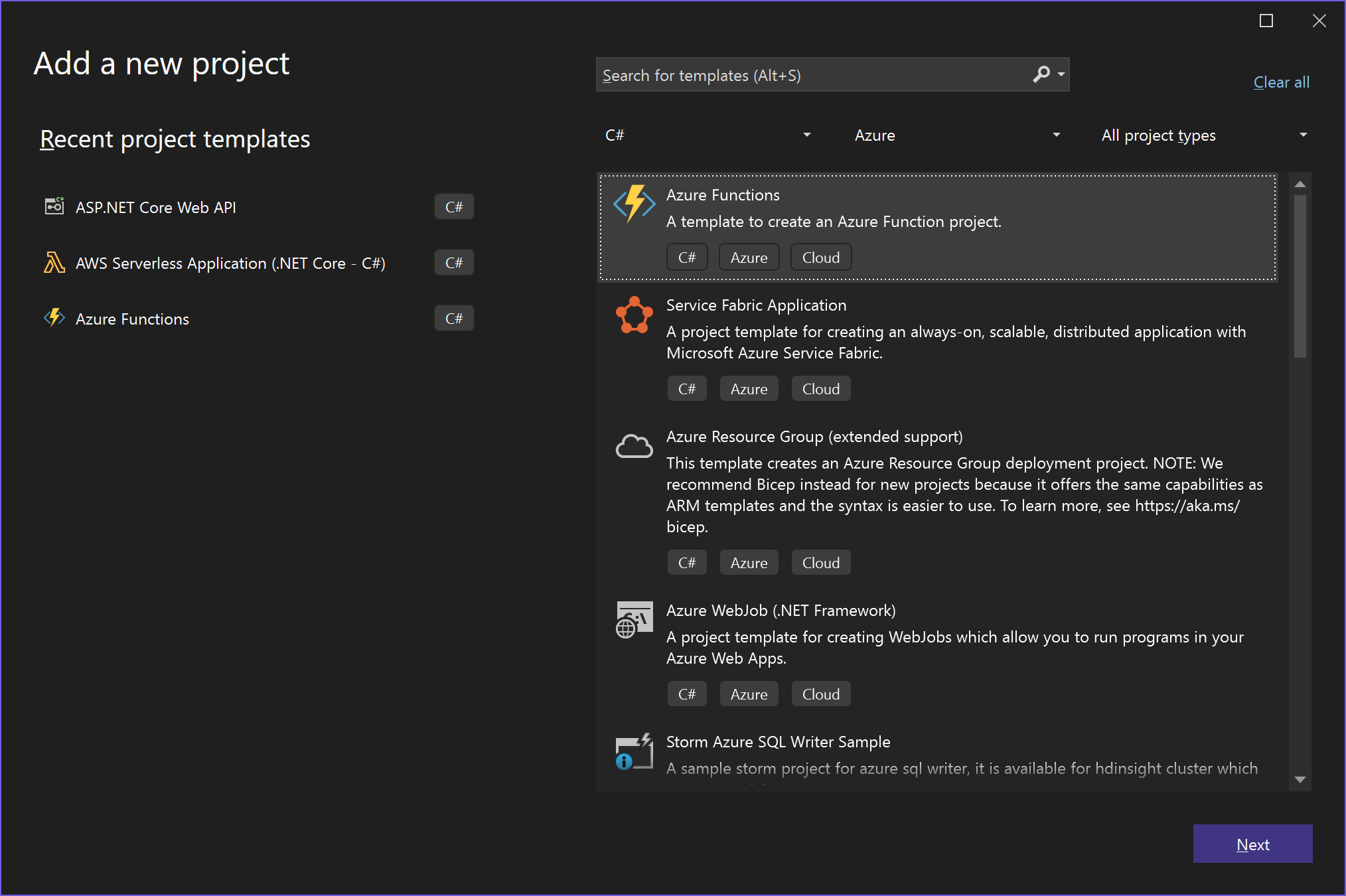
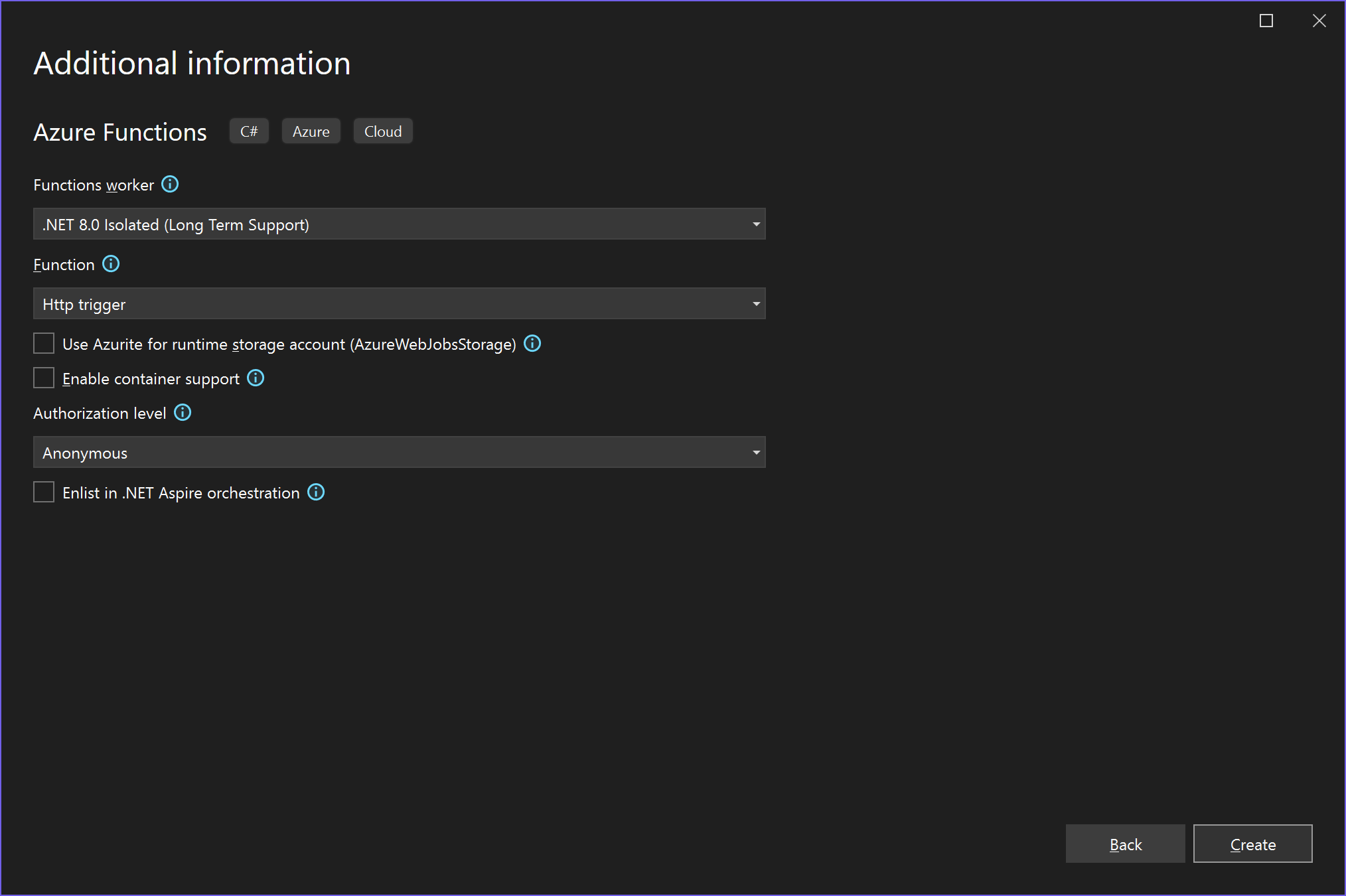
Choose:
- .NET 8.0 Isolated (Long Term Support)
- Http trigger
Commands
using CommandQuery.AzureFunctions;
using Microsoft.AspNetCore.Http;
using Microsoft.AspNetCore.Mvc;
using Microsoft.Azure.Functions.Worker;

namespace CommandQuery.Sample.AzureFunctions
{
    public class Command(ICommandFunction commandFunction)
    {
        [Function(nameof(Command))]
        public async Task<IActionResult> Run(
            [HttpTrigger(AuthorizationLevel.Anonymous, "post", Route = "command/{commandName}")] HttpRequest req,
            FunctionContext context,
            string commandName) =>
            await commandFunction.HandleAsync(commandName, req, context.CancellationToken);
    }
}
- The function is requested via HTTP
POSTwith the Content-Typeapplication/jsonin the header. - The name of the command is the slug of the URL.
- The command itself is provided as JSON in the body.
- If the command succeeds; the response is empty with the HTTP status code
200. - If the command fails; the response is an error message with the HTTP status code
400or500.
Commands with result:
- If the command succeeds; the response is the result as JSON with the HTTP status code
200.
Queries
using CommandQuery.AzureFunctions;
using Microsoft.AspNetCore.Http;
using Microsoft.AspNetCore.Mvc;
using Microsoft.Azure.Functions.Worker;

namespace CommandQuery.Sample.AzureFunctions
{
    public class Query(IQueryFunction queryFunction)
    {
        [Function(nameof(Query))]
        public async Task<IActionResult> Run(
            [HttpTrigger(AuthorizationLevel.Anonymous, "get", "post", Route = "query/{queryName}")] HttpRequest req,
            FunctionContext context,
            string queryName) =>
            await queryFunction.HandleAsync(queryName, req, context.CancellationToken);
    }
}
- The function is requested via:
- HTTP
POSTwith the Content-Typeapplication/jsonin the header and the query itself as JSON in the body - HTTP
GETand the query itself as query string parameters in the URL
- HTTP
- The name of the query is the slug of the URL.
- If the query succeeds; the response is the result as JSON with the HTTP status code
200. - If the query fails; the response is an error message with the HTTP status code
400or500.
Configuration
Configuration in Program.cs:
using CommandQuery;
using CommandQuery.AzureFunctions;
using CommandQuery.Sample.Contracts.Commands;
using CommandQuery.Sample.Contracts.Queries;
using CommandQuery.Sample.Handlers;
using CommandQuery.Sample.Handlers.Commands;
using CommandQuery.Sample.Handlers.Queries;
using Microsoft.Azure.Functions.Worker;
using Microsoft.Extensions.DependencyInjection;
using Microsoft.Extensions.Hosting;

var host = new HostBuilder()
    .ConfigureFunctionsWebApplication()
    .ConfigureServices(ConfigureServices)
    .Build();

// Validation
host.Services.GetService<ICommandProcessor>()!.AssertConfigurationIsValid();
host.Services.GetService<IQueryProcessor>()!.AssertConfigurationIsValid();

host.Run();

public static partial class Program
{
    public static void ConfigureServices(IServiceCollection services)
    {
        services.AddApplicationInsightsTelemetryWorkerService();
        services.ConfigureFunctionsApplicationInsights();

        services
            //.AddSingleton(new JsonSerializerOptions(JsonSerializerDefaults.Web));

            // Add commands and queries
            .AddCommandFunction(typeof(FooCommandHandler).Assembly, typeof(FooCommand).Assembly)
            .AddQueryFunction(typeof(BarQueryHandler).Assembly, typeof(BarQuery).Assembly)

            // Add handler dependencies
            .AddTransient<IDateTimeProxy, DateTimeProxy>()
            .AddTransient<ICultureService, CultureService>();
    }
}
The extension methods AddCommandFunction and AddQueryFunction will add functions and all command/query handlers in the given assemblies to the IoC container.
You can pass in a params array of Assembly arguments if your handlers are located in different projects.
If you only have one project you can use typeof(Program).Assembly as a single argument.
Testing
using System.Text;
using System.Text.Json;
using CommandQuery.AzureFunctions;
using CommandQuery.Sample.Contracts.Commands;
using FluentAssertions;
using Microsoft.AspNetCore.Http;
using Microsoft.AspNetCore.Mvc.Infrastructure;
using Microsoft.Azure.Functions.Worker;
using Microsoft.Extensions.DependencyInjection;
using Moq;
using NUnit.Framework;

namespace CommandQuery.Sample.AzureFunctions.Tests
{
    public class CommandTests
    {
        [SetUp]
        public void SetUp()
        {
            var serviceCollection = new ServiceCollection();
            Program.ConfigureServices(serviceCollection);
            var serviceProvider = serviceCollection.BuildServiceProvider();

            Subject = new Command(serviceProvider.GetRequiredService<ICommandFunction>());

            var context = new Mock<FunctionContext>();
            context.SetupProperty(c => c.InstanceServices, serviceProvider);
            Context = context.Object;
        }

        [Test]
        public async Task should_handle_command()
        {
            var result = await Subject.Run(GetRequest(new FooCommand { Value = "Foo" }), Context, "FooCommand");
            result.As<IStatusCodeActionResult>().StatusCode.Should().Be(200);
        }

        [Test]
        public async Task should_handle_errors()
        {
            var result = await Subject.Run(GetRequest(new FooCommand()), Context, "FooCommand");
            result.ShouldBeError("Value cannot be null or empty");
        }

        HttpRequest GetRequest(object body)
        {
            var request = new Mock<HttpRequest>();
            request.Setup(r => r.Body).Returns(new MemoryStream(Encoding.UTF8.GetBytes(JsonSerializer.Serialize(body))));
            return request.Object;
        }

        Command Subject = null!;
        FunctionContext Context = null!;
    }
}